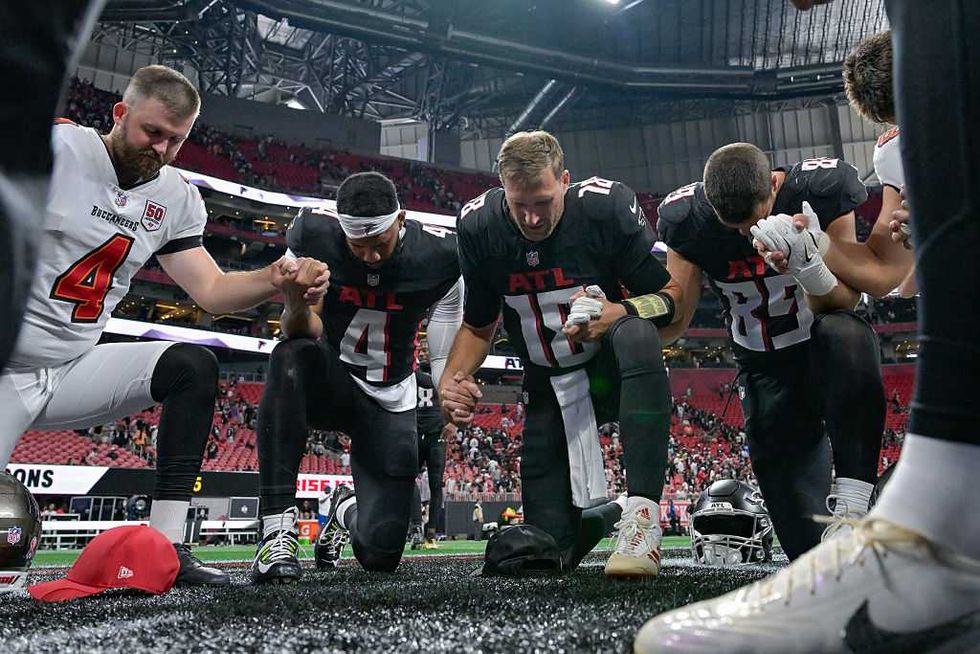
‘Godball’: Are outspoken athletes Christianity’s most powerful evangelists?
Christian affiliation in America has been in steep decline for decades, with church attendance falling and nearly 30% of adults religiously unaffiliated. Pew Research Center has argued that there is “no clear evidence of a religious revival among young adults,” but sports fans might reach a different conclusion when tuning in to post-game interviews and press conferences, where they frequently hear athletes boldly professing their faith and giving glory to Jesus Christ.‘You’re not alone in seeing it, and you’re not alone in recognizing that it is a revival.’While Pew’s latest polling shows that the long decline has only plateaued, New York Times bestselling author and sports journalist Steve Eubanks believes there are undeniable and meaningful signs of revival, particularly among athletes.Teed upIn his forthcoming book, “Godball: How Athletes Are Saving Christianity,” which releases June 9, Eubanks takes a deeper look at the faith resurgence sweeping America and how these outspoken athletes have become Christianity’s most powerful evangelists. “I don’t think I would have noticed it if it hadn’t been for the event that you and I talked about three years ago,” Eubanks told Blaze News, referring to a 2023 incident in which the leading golf publication he then worked for attempted to censor his interview with professional golfer Amy Olson. When Global Golf Post refused to run the piece unless Eubanks removed Olson's references to her Christian faith and pro-life views, he “resigned on the spot.”At the time, Eubanks told Blaze News that widespread leftist bias had created a “sad state of affairs” for journalism. But now Eubanks says the experience had a silver lining: showing him that outspoken Christian athletes like Olson were more common than he realized. “I thought, ‘Wow, for an athlete to say something like this is extraordinary,’” Eubanks told Blaze News. “Well, then I started paying attention, and I thought, ‘Maybe it’s not that extraordinary; maybe it’s something that’s happening every day, and I just hadn’t noticed.’”Jesus firstCombing through press conferences and pre- and post-game interviews proved his hunch correct. More and more athletes seemed to be using the spotlight to profess their faith, sidestepping questions about athletic performance to give thanks to Jesus and share the gospel. “It’s a huge movement now,” Eubanks declared. “Really, it’s a revival.”RELATED: Exclusive: Golf writer says staff 'went ballistic' over story on pregnant golfer's pro-life, Christian views — and outlet's higher-ups refused to run it Steve Eubanks. Image source: Steve EubanksWhen asked why athletes tend to be more outspoken than other public figures, Eubanks pointed to the confidence that comes from succeeding in “one of the few meritocracies left.”LeaderboardSports also instill a willingness to resist the herd, Eubanks said. “From the time they were 7 or 8 years old, they were the leaders of the teams,” Eubanks said. “They had been told by the coaching staff, ‘Look, you’re the person who has to step up.’ And it’s a natural extension of that.”Eubanks asserts one of the main reasons these athletes are speaking out now is tied to the COVID lockdowns. He highlighted that an athlete’s career is significantly shorter than most other professions and that, during the lockdowns, everything they had dedicated their lives to was put on hold for an uncertain, lengthy period.“I just think COVID radicalized these kids,” he stated. “Those people realized that their entire lives could be taken away from them in an instant, and that it was important for them to stand up for the things that were really important and to go ahead and make these proclamations of faith.”He argued that athletes have become the “cultural drivers” of American society, more so than artists and musicians.Bad betsEubanks hopes that church attendance, particularly among young men, continues to grow, but expressed concern about one emerging threat within the sports community that could impact the current Christian revival. Image source: Steve Eubanks “If there’s anything that could derail it, it is the sports gambling,” Eubanks told Blaze News. “It can compromise the integrity of the sports themselves.”He detailed how throwing a game used to mean deliberately manipulating the entire outcome, but recently, some athletes have been indicted for allegedly engaging in spot-fixes, rigging small moments, such as a specific baseball pitch, for prop bets.Eubanks also noted that the barrier to gambling has been substantially lowered, from having to seek out a local bookie to using your phone to place numerous bets in seconds.“It’s almost the slot machine effect. There’s just enough bells and whistles to keep you engaged and to keep you throwing money down the rathole,” he said. “There’s a huge, huge addiction problem out there with this that we haven’t recognized yet, but that could really derail this revival movement in my eyes.”RELATED: When Archie Comics found Jesus: Strange artifacts from a once-Christian culture Sydney McLaughlin-Levrone. Erica Denhoff/Icon Sportswire/Getty Images Walking the walkTo sustain and grow the revival, Eubanks believes athletes must become more vocal about their faith and take a stand against immoral practices in the sports industry, including opposing sports betting and the playing of songs with obscene lyrics at stadiums and arenas.“In order to walk the walk, you’re eventually going to have to stand up and say, ‘This is not right; we shouldn’t be doing this,’” he said.Eubanks hopes that readers of “Godball” understand this revival movement is significant and expanding. He also aims to inspire young athletes to express their faith publicly, which could spark a domino effect of fans being drawn to Jesus Christ.“There’s an entire legion of people out here who are seeing exactly the same thing. You’re not alone in seeing it, and you’re not alone in recognizing that it is a revival,” he stated.Like Blaze News? Bypass the censors, sign up for our newsletters, and get stories like this direct to your inbox. Sign up here!