A Short Course in the Secret War
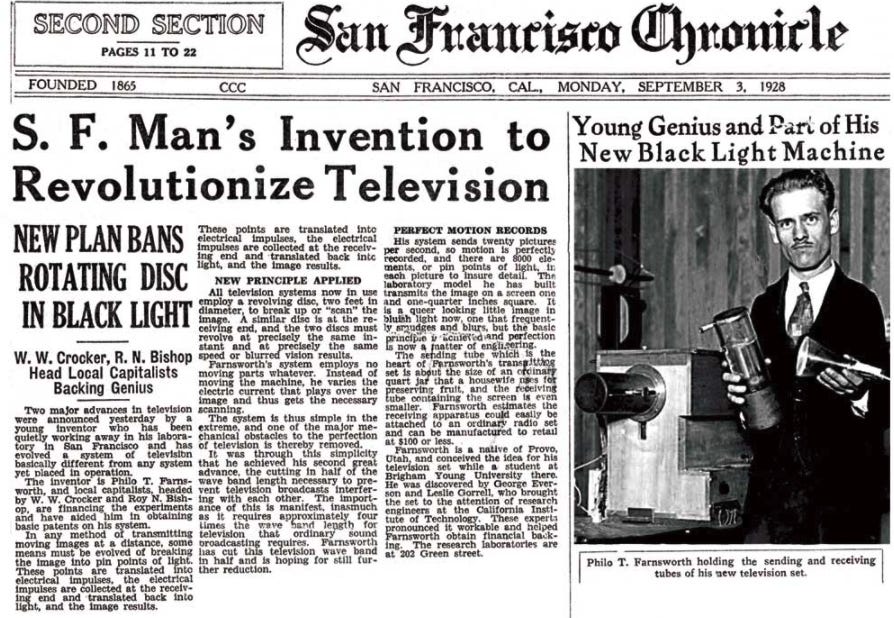
California’s been broadcasting trouble to the world for over a century now. Television wouldn’t exist without a banker in San Francisco and a young genius from Utah & Idaho who established a lab there in the interwar period. That young genius was Philo Farnsworth. Since I wrote the dispatch above this summer I’ve spent about an hour every time I’m on campus at the University of Utah sitting in their gorgeous, earthquake-proof reading room on the fourth floor of the J Willard Marriott Library (shoutout to all the excellent librarians and archivists out there, you all rule). While pawing through the Farnsworth papers—I’ve gone through about fifteen archival boxes by now, photographic each page, to assemble my own archive as I did with the Frank Wisner archives at University of Virginia’s Albert and Shirley Special Collections Library—I realized there was a crossover character, someone I’d come across in the Frank Wisner papers in Charlottesville. That crossover character is, of course, a Californian, the banker’s son. James McCargar was born into a wealthy San Francisco family. His father Jesse McCargar, was a banker at Crocker Bank. He was also, in James’s words, an “industrialist” who established a private financing syndicate for Philo Farnsworth’s early work into television. He set Farnsworth up with a lab and equipment near Telegraph Hill, at 202 Green Street. • • James McCargar saw an early version of television at this lab. Here it is in his own words: • • James McCargar went to Stanford, joined the State Department, and became a spy for John Grombach’s the Pond while officially covered as a diplomat in Hungary. There’s an excellent State Department Oral History (https://www.adst.org/OH%20TOCs/McCargar,%20James.toc.pdf) that I of course encourage you all to read in its entirety. After working for the Pond, he went to work for Frank Wisner in the Office of Policy Coordination. He did a job for James Angleton during the McCarthy hearings where he fed McCarthy a bunch of disinformation that led to McCarthy going after a different target than the CIA…and I’ll get into the rest of it later.
• • The Lecture *** Just a quick break the fourth wall note here: if you’re interested in doing any of this kind of stuff yourself, there’s absolutely zero barrier to entry beyond time and access to a University library. The research takes a while to learn how to do effectively, but the librarians and archivists are generally all quiet geniuses who live for detective work, so ask them questions and then watch how they go about solving the problem and learn from it; generally universities have seminars and classes on how to use the library, you can ask to sit in on some of those. Public school libraries—such as University of Virginia or University of Utah—have a mandate to assist the public, so anyone belongs there, don’t be intimidated. Dress professionally, have some idea what you’re looking for, and follow the rules. Generally you can’t bring your own writing implements or paper, they have pencils and colored paper that doesn’t get mixed up with the archived stuff, photos are fine but no flash, and if you need something . Private school libraries are very responsive to outside researcher requests, I’ve had excellent interactions with Georgetown University’s special collections, for instance, and plan to spend some time down at BYU’s Special Collections next semester. Yale’s Special Collections library is the coolest place, just beautiful. If you find anything neat, let me know!
First, McCargar was in The Pond. The Pond, of course, was a spy agency set up by the Army to spy on the OSS. It mostly operated through commercial cover—the Dutch Philips Corporation, Insurance Agencies, the media—but each station had one officer (uniformed Army on Attache duty or, in the case of McCarcgar, a State Department official who was the son of the Chairman of the Farnsworth-Capehart Corporation and an executive with Crocker Bank) who double dipped as a Pond Officer. They had their own orders and reported only back to Grombach and the Pond—existence was kept secret from the Navy and the FBI until the FBI started investigating Grombach and the Army read J. Edgar Hoover in. Get the Full Read In—Join “The Hunt for Tom Clancy” today as a paid subscriber. It will bring you joy. Grombach and Hoover were two of the most ardent anti-Communists then in Federal Service and cooperated during the war; Hoover would later think of Grombach and a con-man and Grombach would praise Hoover in the introduction to his 1980 book The Great Liquidator — an account of his best source in Paris during World War 2, a French Doctor, politician and serial killer who played all sides.
This all goes back to an incident early on in World War II where the Army G-2, fearing Communists or Anarchists, bugged Eleanor Roosevelt’s hotel room while she was — ahem — engaged in relations. The Army officers briefed the President. Franklin Roosevelt was furious and ordered everyone involved sent to the South Pacific to “fight the Japs until they are killed.” That led to Franklin Roosevelt finally taking up fellow New York White Shoe Lawyer (and Republican) William Donovan on the proposal to set up a spy agency that the President could trust. Subscribe now
          Read more
       (https://thehuntfortomclancy.substack.com/p/a-short-course-in-the-secret-war)
Write a comment