"That’s what I’m always saying to that Rosicrucian there"
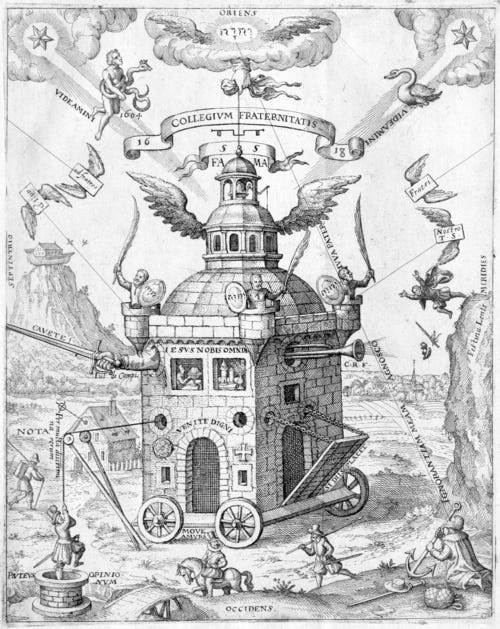
Dear Crew of the USS Tom Clancy, Please Enjoy this piece on James Joyce and the Brotherhood of the Rosy Cross. Matt • • The representation was created around 1604 and was published in the Speculum sophicum Rhodostauroticum by Theophilus Schweighart. At the center of the picture is a wheeled, fortress-like building. Look at the picture from the OCCIDENS, i.e. from the west. The lower image caption provides us with an indication of this (it is difficult to recognize here in the picture). The entrance to this building, which is directly revealed to the viewer, is marked by a lettering. Above the archway you can read “VENITE DIGNI” (”COME HERE, WORTHY”). To the right of the archway you can see a cross and to the left a rose. Directly below the entrance you can read the word “MOVEAMVR” spread over two lines. Above the archway there are two windows along which the lettering “IESVS NOBIS OMNIA” (”JESUS [IS] EVERYTHING FOR US”) runs along. It therefore becomes clear that, in addition to all the many other symbolic representations, it could be a rose cruiserical representation. The cross and rose can be clearly identified, but not presented united, as in today’s form. (Wikipedia Commons) “for Art is a revelation, and not a criticism, and the life of the artist is in the old saying, ‘The wind bloweth where it listeth, and thou hearest the sound thereof, but canst not tell whence it cometh and whither it goeth; so is every one that is born of the spirit.” —William Butler Yeats, The Body of the Father Christian Rosencrux (1903) • • James Joyce and Nora Barnacle. 1930. (Photo by: Marka/UIG via Getty Images) (https://www.poetryfoundation.org/poets/james-joyce)James Joyce embedded references—some clear, some masked—to the Rosicrucian Order and its ideas throughout his work. This paper will examine some of those references and attempt to explain their presence and function in Joyce’s corpus both as a reflection of the zeitgeist of the time and as part of a long, competitive conversation with his fellow Irish modernist William Butler Yeats. In the autumn of 1902, outside the National Library of Ireland, James Joyce first met W.B. Yeats. By this point William Butler Yeats was well into his magician phase, having been inducted into the Order of the Golden Dawn in 1890. Golden Dawn was a magical order heavily influenced by AE Waite’s The History of the Rosicrucians. Yeats met fellow Waite enthusiast MacGregor Mathers, author of The Kabbala Unveiled, three years prior in the British Museum Reading Room (Howe, 42). • • Item #58649 The Kabbalah Unveiled, containing the following books of the Zohar: The Book of Concealed Mystery, the Greater Holy Assembly, the Lesser Holy Assembly. Translated into English from the Latin version of Knorr von Rosenroth, and collated with the original Chaldee and Hebrew text. S. L. MacGregor MATHERS, Knorr von Rosenroth. (Weiser Antiquarian (https://www.weiserantiquarian.com/pages/books/58649/s-l-macgregor-mathers-knorr-von-rosenroth/the-kabbalah-unveiled-containing-the-following-books-of-the-zohar-the-book-of-concealed-mystery?soldItem=true)) A key Rosicrucian work contained in Waite’s history was a translation of the 1600’s manifesto Chymische Hochzeit ChristianiRosencreutz (The Chemical Wedding of Christian Rosenkreutz). The Chemical Wedding idea is an old one with roots in alchemical principals; a depiction of the chemical wedding can be found on the Ripley Scroll, an alchemical text from 1590. It simply means the chemical combination of two substances, or the philosophical union of two sets of contradictory principals—the sun and the moon are the symbols used in the Ripley Scroll (Princeton PUL). • • The Ripley Scroll (Princeton (https://catalog.princeton.edu/catalog/99108636323506421#viewer-container))One can consider the meeting of Joyce and Yeats outside the Irish Library a Chemical Wedding of sorts; the ideas and inspiration springing from this meeting, often oppositional, creates its own sort of philosophical union. Alchemy, you know you want to read more
          Read more
       (https://thehuntfortomclancy.substack.com/p/thats-what-im-always-saying-to-that)
Write a comment