The Man From Mississippi Who Made This World
Dear Crew of the USS Tom Clancy, Thank you so much for subscribing—I realized that I have never shared the full results of my research into Frank Wisner and that I should start doing this now. This is drawn from my Master’s Thesis and spiced up with some things that didn’t make it into there. It is springtime here in Salt Lake City and I am beginning to get back in the groove of life after a winter that was, well, a winter, so expect many more dispatches in the coming weeks and also note that I’m cooking up something for summer that I think you’ll like, so if you haven’t yet made the jump and become a paid subscriber, might be a good time to do that. -Matt Become a paid subscriber now. With that…let’s get to it.
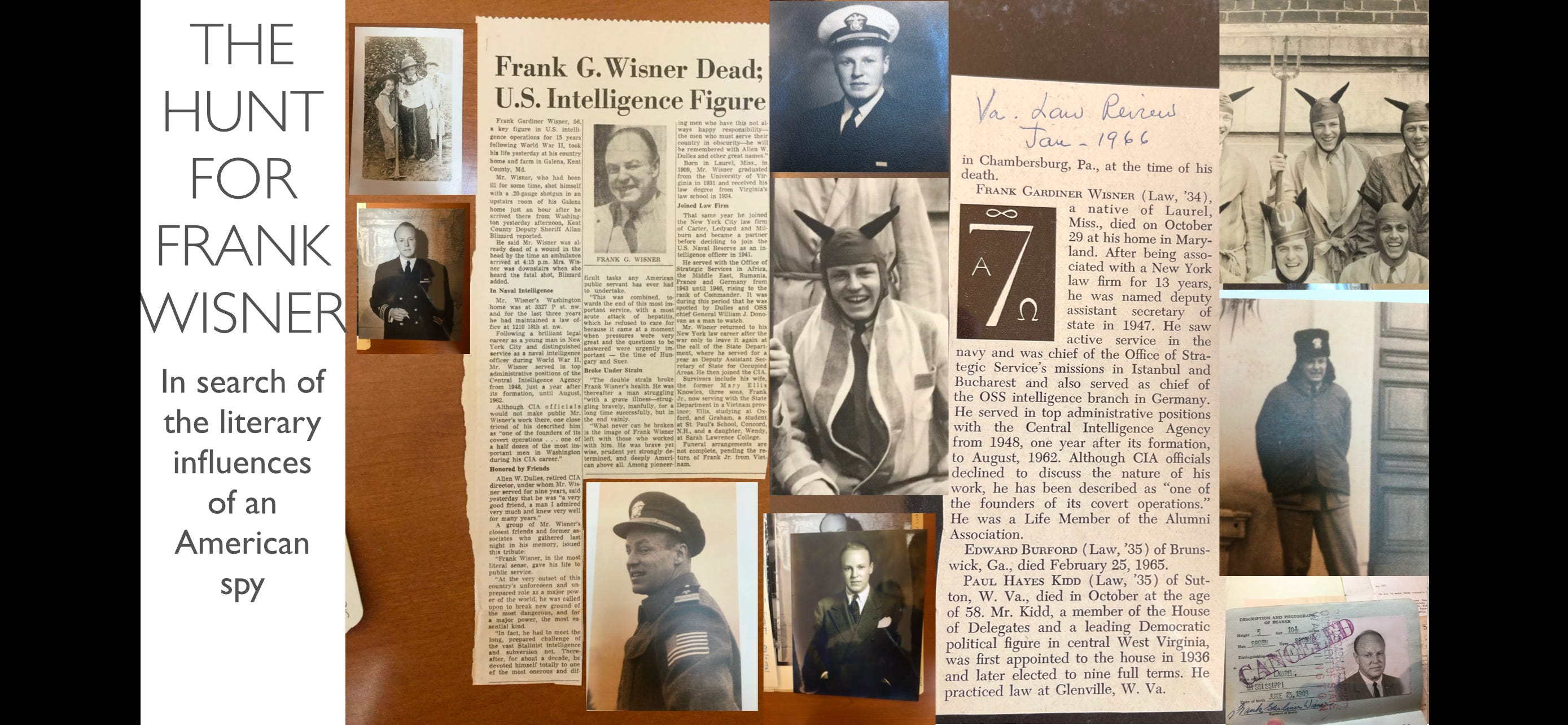
• • In the twilight years of his life—which would end by a self-inflicted twenty-gauge shotgun blast to the right temple on October 29, 1964 on the second floor of an antebellum farmhouse on the eastern shore of Maryland—CIA graybeard Frank Wisner turned his attention to influencing two facets of American life: education and literature.
It was a logical project for a master spy in semi-retirement. He spent his clandestine life in both the Office of Strategic Services (OSS) and Central Intelligence Agency (CIA) trying to influence both spheres overseas for the last twenty years. One of the greatest weapons at his disposal was his lawyerly gift for persuasion through language—spoken words, pamphlets, books, poems, Presidential Findings.
At Wisner’s memorial service, CIA Director Richard Helms, a former journalist for UPI and longtime OSS and CIA colleague, closed his keynote remarks recalling the departed’s literary sensibility:
I have made no reference to Frank’s sense of humor and love of language. Yet to his associates they went hand in hand and brightened many a difficult meeting. From his early upbringing and study of the law, Frank developed a genuine affection for style, whether he was telling one of his own Mark Twain-like stories or composing a policy paper for the National Security Council… One of his favorite phrases was “lets find some language” (Frank Wisner Memorial Service, Director of Central Intelligence Remarks Central Intelligence Agency 1965)
• • A Memorial Display after Wisner’s passingWisner, a University of Virginia trained Wall Street lawyer, was the founder and first director of the “Office of Policy Coordination,” a secret organization that worked directly for the National Security Council after World War II. His job, as prescribed by National Security Council Directive 10/2 (June 18, 1948), was to coordinate:
Any covert activities related to: propaganda, economic warfare; preventive direct action, including sabotage, anti-sabotage, demolition and evacuation measures; subversion against hostile states, including assistance to underground resistance movements, guerrillas and refugee liberation groups, and support of indigenous anti-communist elements in threatened countries of the free world. (NSC 10/2, 18 June 1948)
Wisner advocated for and eventually created this kind of capability for the Executive Branch after running covert intelligence collection operations for the Office of Strategic Services during World War II at various levels.
Taking leave from his Wall Street white shoe law firm, Carter Ledyard, which counted President Franklin Roosevelt as an alumnus, Wisner heard the whistle of war emanating from Rockefeller Center (which housed the British Security Coordination Committee) and commissioned in the Navy shortly before the United States entered World War II. Wisner’s military career began at the District Intelligence Office in the 3rd Naval District.
There, he worked at the Post Office’s cable censor and as the liaison officer to the National Censorship Branch Intelligence section, tasked with radio and telegram censorship, which really meant reading the mail for counterintelligence purposes (Maior 40). He chafed at the work, but did it in the style Helms recalled, receiving excellent evaluations but later in life describing the censorship job with the pun “being given command of a Cutter” (Box 20 Folder 8 MSS1509).
Lieutenant Turner McBaine—who in civilian life was Standard Oil’s lawyer—then got Wisner an assignment with the OSS Station in Cairo, the transfer helped by UVA’s Robert Kent Gooch. Wisner was sent to a covert facility in Maryland for spy training and was initiated into the mysteries of the British-inspired intelligence system America was building.
• • Wisner in Naval Uniform; he’s buried in Arlington with his Navy Rank, Commander, under his name. No mention of CIA or OPC or OSS. The British espionage world was one entwined deeply with British literature and filled with literary officers and spy poets—William Donovan, wartime Director of the OSS, was counseled by MI-6 officer Ian Fleming in the formation of the agency; Roald Dahl was soon to arrive in America as a spy after a short stint as an RAF Aviator in Baghdad and Greece (Maior 41). After Cairo, Wisner was assigned to reorganize espionage operations in wartime Istanbul, and then was sent to Romania after the Soviets took over (the previous government of Romania was allied with the German Nazis).
Part of Wisner’s cover was as a liaison officer for the repatriation of American B-24 crews who’d been shot down bombing oil refineries north of Bucharest. This was a cover job he performed with aplomb, commandeering every bus in the city to ferry prisoners of war to a convoy of bombers and cargo planes that would evacuate the POW’s to allied territory—the whole project known as “Operation Gunn.”
Wisner took the job over from an OSS Officer named 2nd Lt. George Bookbinder, the literary thrust of the war was strong and sometimes even nominative. Wisner, whose Bucharest code name was TYPHOID, also ran a spy on the Romanian General Staff’s G-2 (intelligence) section whose code name was TONSILLITIS who fed him excellent material from the Soviets (Romanians had penetrated the Soviet intelligence services). One of his best high-level sources was Teohari Georgescu, Romania’s undersecretary of state for national economy; he passed along the message that the Soviets demanded to “control all publicity and propaganda including the press, radio and public spectacles” (Brown)
To counter the Soviets, Wisner would later seek to replicate this method. In Bucharest, on the surface, Wisner was the life of the party. He did card tricks, wowed the Romanian Royal family with his ability to shoot a shotgun accurately over his shoulder (using a small, circular mirror), spun yarns.
Under the surface, he was gathering information for the OSS on both the Nazis and the Communist Party. His University of Virginia training—where he scored the highest score on his take home psychology exam senior year, pledged DKE, Captained the Track Team, was tapped for the IMPs, Eli Banana, the 13 Society and, it was learned after his death, was also tapped as a Seven—was evident in Wisner’s method of operation (Corks and Curls 1931 p 229).1 (#footnote-1)
• •
Wisner’s Romanian biographer, who was also the Romanian ambassador to the United States, called it “sprezzatura” a term from Baldassare Castiglion’s 1528 The Book of the Courtier. It means “a certain nonchalance, so as to conceal all art and make whatever one does or says appear to be without effort and almost without any thought about it.” The effect of Wisner’s “sprezzatura” would soon be felt globally and is still felt today.2 (#footnote-2) 3 (#footnote-3)
If you’ve read this far you’ll want to read on
          Read more
       (https://thehuntfortomclancy.substack.com/p/the-man-from-mississippi-who-made)
Write a comment