Variations on Repair
Dear Crew of the USS Tom Clancy,
As many of you know, I’m in an English Literature PhD Program at the University of Utah now, having a great time. Just as my Master’s program at the University of Virginia got me thinking about all sorts of new things about the Rosicrucians at Ephrata Cloister and the literary bent of early CIA plank owners like Frank Wisner, school’s been taking me in some interesting directions recently.
Easily my favorite class—perhaps of all time—has been my paper making class. Paid subscribers have been seeing bits and pieces of this in the chat, but I have a piece due for class and an artist’s statement to write for it, so I figured I might as well do a little bit of both.
Matt
This is a free dispatch from “The Hunt for Tom Clancy” but you should also become a paid subscriber to support this work
Variations on Repair The idea came to me during the third phase of a breath work class at a Weed Church in Salt Lake City, across from a movie theater. During the second phase, I’d talked to dead people, so a bit of an off ramp with creative stuff was necessary.
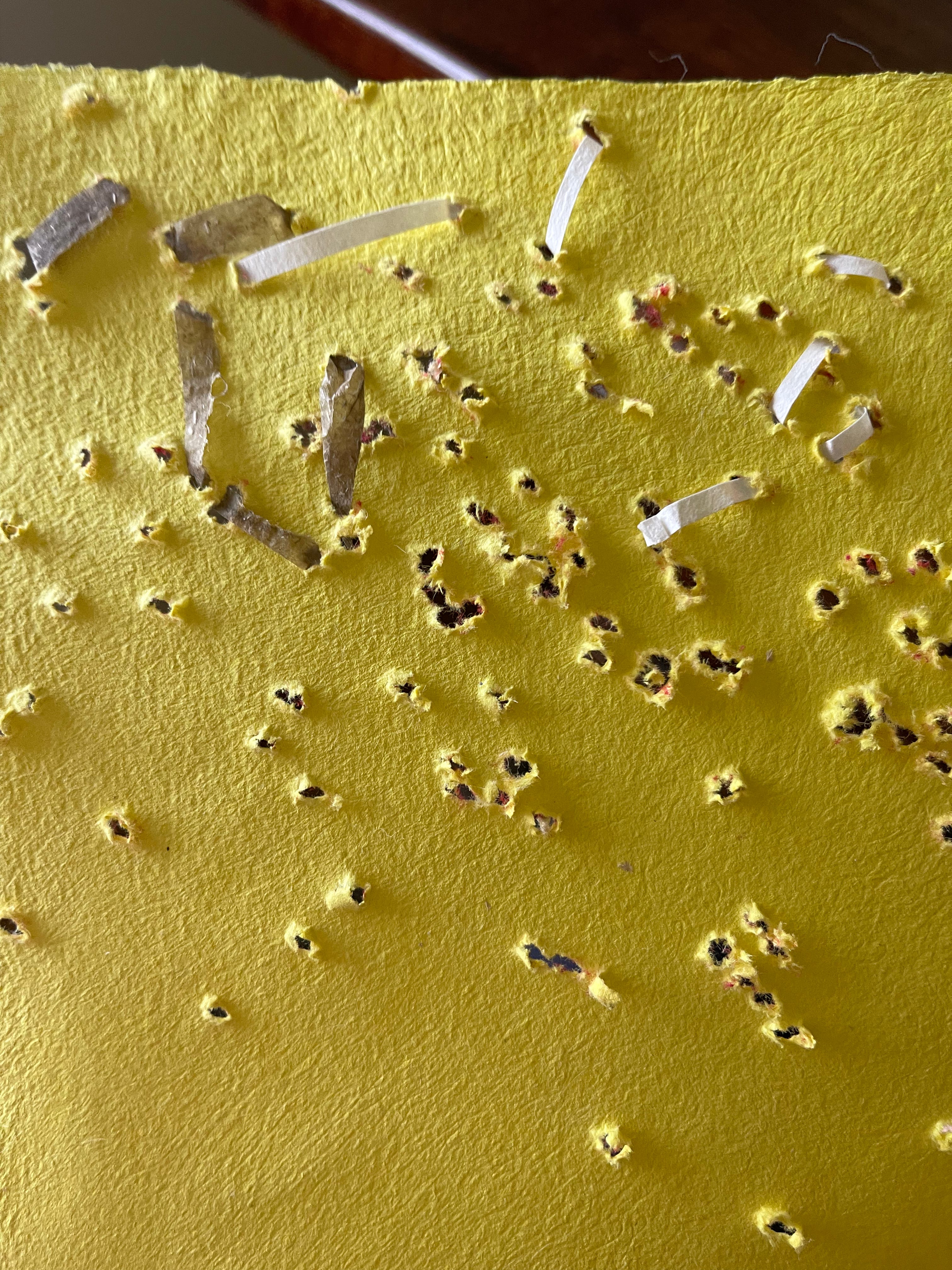
So. Breath work. You lay on your back. You engage in holotropic breathing. You hyper-oxygenate your blood stream. You listen to Nikki. Pretty soon, after talking with some dead friends in the second act, and in the third act I realized what I would do for my final paper making project. One option was doing some sort of art using the paper itself. In my mind, I saw myself shooting the paper I’d handmade with a .410 Turkish shotgun, then using thin strips of paper the portions that had no pellets punch through, I could repair the damage.
Papermaking is a beautiful art, one that comes from destruction and transformation. Flax is pulverized, boiled and transformed into fiber; ditto with cotton, sisal, kozo or any of the other materials we worked with.
Therefore, why not play with this concept a bit? After all, paper making starts with destruction: something is pulped, soaked, made formless. This sludge then attains a form through a mould and a deckle and becomes paper.
So it’s not much of a leap to go from this, to this, to this:
• • • • • • I did a couple of test cases: the paper you see above was flat, clipped together, suspended near a post. This paper was rolled into a tube.
A remarkable thing was the paper’s strength: when I got home and unrolled the tube, which I eventually cut into the shape on an American flag, I discovered at least three shotgun pellets that were embedded within the paper itself. The interior layer, a broadsheet of flax and cotton I believe, was almost undamaged, the shotgun pellets having been deflected by or embedded in the other layers. It was remarkable.
And here are the results: more stars were added to the American Flag, but you get the idea.
• • And here’s the sheets for “Variations on Repair”
I found that the randomness of the shotgun’s pellet distribution repaired with thin strips of contrasting color paper mirrors the small pieces of American currency embedded within some of the sheets in a pleasant way. I also liked the idea of re-weaving something that has already been woven, but damaged, and not hiding the repair but making it visible.
No one else is doing it like this. Be a crew member on the USS Tom Clancy for the price of a coffee today
Obviously this is all a metaphor for my war experience, post war experience, and the way I’ve found solace in paper (making it, writing on it, reading it) in those times. Just as my scars are visible on my face, so too are the scars visible on the paper. Both, in my opinion, look cool.
And I’ve gotten so into this that I’m going to grow my own flax and make a farm to table book, so stay tuned.
Until next Dispatch,
Matt
Tell your friends!
Share
Write a comment