Fatal B-52 Bomber Crash Kills Eight at Edwards Air Force Base
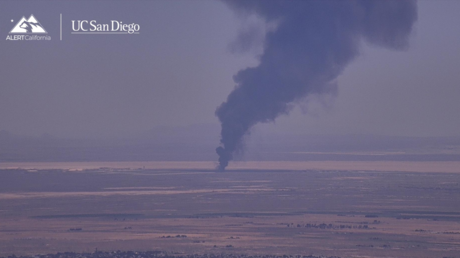
Fatal B-52 Bomber Crash Kills Eight at Edwards Air Force Base A routine test flight turned catastrophe at Edwards Air Force Base is being framed, not as a mystery or a scandal, but as a tightly managed tragedy — and that contrast is telling.
On the official side, outlets echoing military briefings emphasize procedure and containment. RT leads with the hardware, calling it a “US Nuclear-Capable B-52 Bomber” crash in California, foregrounding the strategic payload and the symbolism of losing such an aircraft. Russian state agency TASS sticks to sanitized bullet points: “US Air Force B-52 Stratofortress bomber crashes at Edwards Air Force Base,” with “preliminary reports” of eight dead, and a separate note that there are “Likely no survivors in B-52 bomber crash — air base.” Another TASS dispatch stresses that causes are “not available at this point,” while yet another reduces the fallout to airspace management: “California bans flights within 13-kilometer radius of airbase following B-52 jet crash.”
The picture here is technocratic: a strategic bomber lost, eight dead, investigation pending, airspace secured. The narrative is about control.
The opposition-leaning Investigative News Service (INS) sharpens the human and institutional angles. Its headline – “B-52 Stratofortress Bomber Crashes in California, Eight Dead” – is blunt, but the body goes further: the jet “crashed on the runway… and caught fire,” the crew included “civil servants and representatives of government contractors,” and Boeing itself confirms “two of its employees” among the dead. Where TASS and RT hover at altitude, INS dives into the mix of military, state, and private industry on board.
There’s also a quiet contrast in what’s missing. Government-aligned coverage leans on formal phrases and airspace maps; the opposition piece spotlights the lethal intersection of test flights, contractors, and a platform built to “carry a wide range of nuclear and conventional bombs.” One side is managing an incident; the other is implicitly questioning the cost of keeping a 1950s-era nuclear workhorse in the sky.
Write a comment