Day 78: Building Production-Ready ML Pipelines for Intelligent Log Classification
Day 78: Building Production-Ready ML Pipelines for Intelligent Log Classification
What We're Building Today
Today you'll transform your distributed log processor from a passive collector into an intelligent analyzer by building a complete machine learning pipeline. Here's what we'll accomplish:
Core Components:
Skills You'll Master:
End Result: A working system that classifies log severity and category with 90%+ accuracy in under 100ms, complete with web dashboard and Docker deployment.
The Intelligence Gap in Modern Log Processing
Traditional log processing systems excel at collecting, storing, and querying massive volumes of data. However, they're fundamentally reactive - you discover problems only after manually searching through logs or when alerts fire based on predefined rules.
Production systems at companies like Netflix generate over 1 trillion log events daily. Without intelligent classification, engineers spend countless hours manually triaging alerts, often missing critical patterns that emerge across distributed services. The cost of reactive monitoring scales linearly with system complexity, creating an unsustainable operational burden.
Machine learning transforms this dynamic by enabling proactive log analysis. Instead of waiting for explicit error patterns, ML models detect subtle anomalies in log characteristics that precede system failures. This shift from reactive to predictive monitoring represents a fundamental evolution in operational intelligence.
[

](https://substackcdn.com/image/fetch/\)s!Z0hO!,fauto,qauto:good,flprogressive:steep/https%3A%2F%2Fsubstack-post-media.s3.amazonaws.com%2Fpublic%2Fimages%2F19fe77b7-793e-44c8-a5ea-30e3b30b1e96_1800x1400.png)
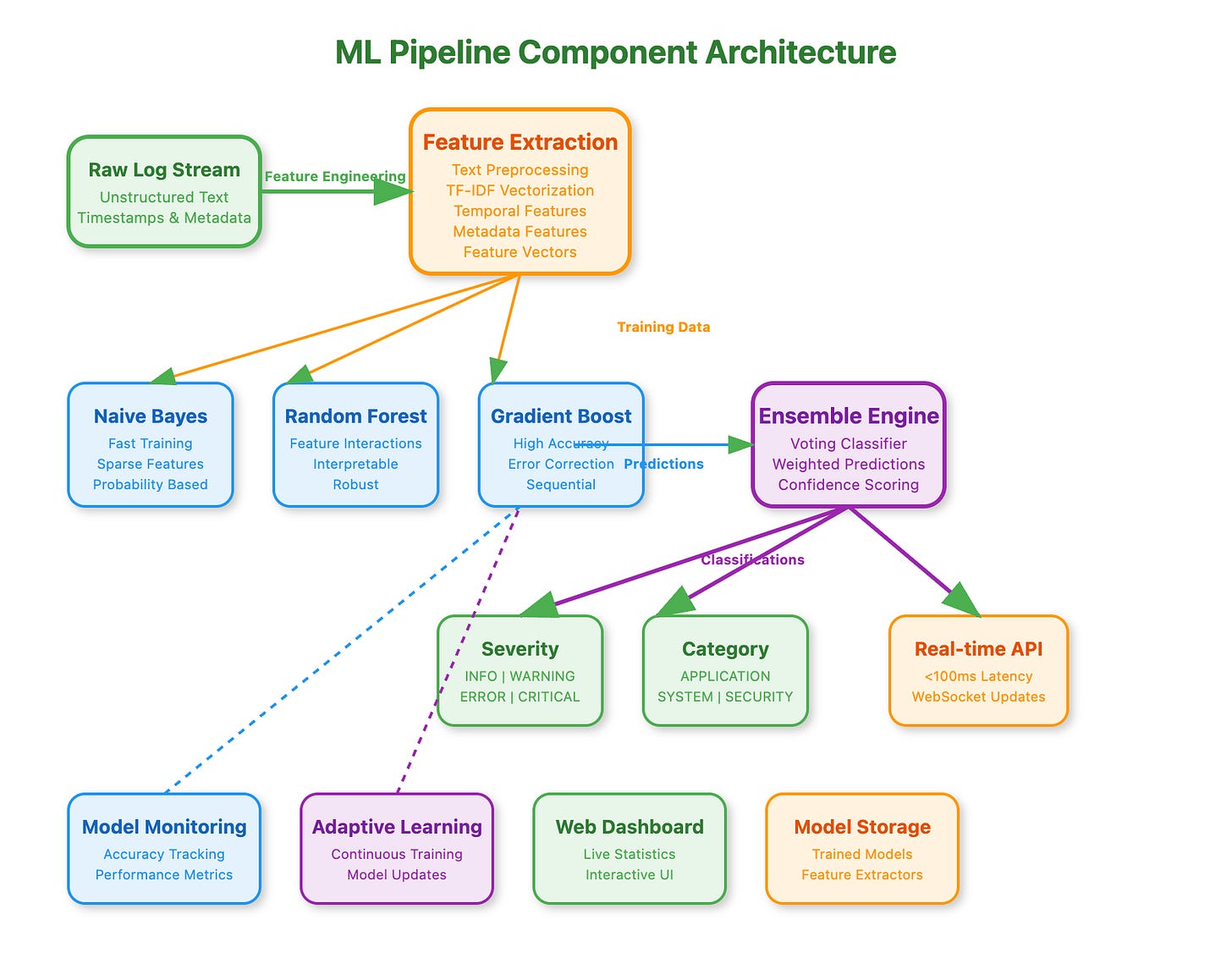
\[ COMPONENT ARCHITECTURE DIAGRAM \]
Core ML Concepts for Log Classification
[Read more](https://sdcourse.substack.com/p/day-78-building-production-ready)
Write a comment