Article Not Found

The article could not be found.

Try searching or paste a Nostr address (naddr)

If you have the article's Nostr address (naddr), paste it in the search box below. We'll attempt to fetch it from the relays and add it to our index.

Looking for people? Search users

Cover image for Bitcoin “Crossing the Chasm” and the DEATH OF ENERGY MISINFORMATION

Bitcoin “Crossing the Chasm” and the DEATH OF ENERGY MISINFORMATION

I am an impact investor, more recently specializing in climatetech. Before that I was I ran a technology company. These experiences gave me some insights into the challenges that all new technologies face in achieving mainstream adoption. Bitcoin currently faces this same challenge. Let’s zoom in to where the chasm could be crossed, and what currently is holding it back. There is 65 Trillion of institutional investment that wants to invest in bitcoin but thinks they can’t (30 Trillion in impact funds, and another 35 Trillion in Sovereign Funds excluding Central Banks). The reason they think they can’t is they believe Bitcoin is a bad ESG story. This article investigates this claim in depth, against the backdrop of other disruptive technologies, so we can better spot trends, and filter out likely good information from likely misinformation. When I first heard the claim that Bitcoin could be positive for the environment, as an environmental campaigner and climatetech investor I was skeptical. After considerable due diligence however, I realized that there was a strong evidential basis to this claim, which I outline here. This question if very important, if not the most important question Bitcoin’s supporters must answer to the next group of potential Bitcoin adopters, because the “early majority” care deeply about environmental impact. In order that Bitcoin “crosses the chasm” from early adopters to the early majority, addressing Bitcoin’s (true) environmental impact must be addressed. There is no bypass, no shortcut for this. Unless and until this issue is addressed, Bitcoin will not “cross the chasm”. In Bitcoin’s adoption curve, the estimated 4.7% who hold Bitcoin are the early adopters. The next wave includes institutional investors, which in turn includes sovereign funds and ESG funds. They are the early majority. The early adopters tend to be highly suspicious of mainstream media. However the Early Majority are only somewhat skeptical. As a result, they have different beliefs about Bitcoin today. Here is a sample of statements that people who interface with, or sit on the Compliance Divisions and ESG Investment Committees of Sovereign Wealth Funds shared with me recently about Bitcoin. I have limited knowledge about Bitcoin other than “it’s bad for the environment, don’t touch.” “It’s conflicting with the idea of a Central Digital Currency so it can be very confusing for someone who’s not in the space” “We have other issues we have to solve before we think about Bitcoin” “I’ve heard of a lot of backlash against Bitcoin because of criminal activity and the dark web” “It’s using so much water. It’s using drinking water.” While these messages are not anchored in fact, they do represent the current opinion-set. Existing Bitcoin proponents must meet these people where they are at if they are to have any hope of changing this opinion-set, no matter how good the data. There are 3 stages to shifting these perspectives so that that early majority can invest in Bitcoin without value conflict Screening out noise Identifying false signal Reading pure signal Let’s address each in turn. 1. Noise Reduction The best way we can clear most of the noise around Bitcoin is not to start with Bitcoin, but to understand something I learnt while running my first technology company: if you’re going to bring a disruptive technology to the planet, you better be prepared for a lot of gaslighting from the people you disrupt. This has happened to every disruptive tech since the telegraph in an unbroken chain of 21 technologies across 160 years. Let’s zoom in. Here’s some samples of how disruptive technologies and devices have been greeted through in the last 160 years. As we can see, long before Bitcoin was labelled by the media as an existential threat to humanity, the teddy bear was! Let’s zoom in a little more. I could have chosen anyone one of 21 industries but have chose two that like bitcoin disrupted multiple industries. The first was the bicycle. When the bicycle first rose to prominence in the 1890s, it disrupted horse drawn transport, riding apparel, public transit and the railway industry. As the disrupted industries launched their counteroffensive, new junk science came in almost immediately. Next, without empirical evidence, medical experts and academics started referring to four invented conditions you that you could supposedly get by riding a bicycle This created the environment of moral outrage where regulators and policymakers, who gained their information primarily from mainstream media, felt the right thing to do was to call for bans and restrictions. Source The prevalence of the term “bicycle face” serves as a guide as to when misinformation about the bicycle peaked, and how long it took to eventually die out. source: Google Ngram Viewer The bicycle was no one off event. The response to another technology that disrupt multiple industries, the radio, followed an almost identical pattern. Immediately after the radio began rising to prominence in the 1920s, junk science about the radio was reported in the mainstream media. The radio was blamed for everything from jailbreaks to snowstorms. Next, without empirical evidence, medical experts and other authority figures started referring to four conditions that you could supposedly get by listening to the radio. Once again, this created the environment of moral outrage where regulators and policymakers, who gained their information primarily from mainstream media, felt the right thing to do was to call for bans and restrictions. source: pessimistsarchive.org The chart on radio misinformation in mainstream media took on an uncannily similar shape to the earlier bicycle misinformation chart: an initial peak around 7 years after inception, but then a long tail with several smaller peaks within that tail. The similarity is even more striking when we view the charts side by side. Bitcoin’s journey has been almost identical to that of the bicycle and the radio. Bitcoin disrupts (at least) four industries: Central Banks, Banking, The Gold Industry and Remittance Payments. Bitcoin has been met with similar junk science, as we will investigate in the next section “false signal”, which has again created the environment where policy-makers and regulators who rely heavily on mainstream news sources for information have felt it appropriate to call for bans and restrictions. We are currently about here in the media cycle around Bitcoin and energy. The key takeout is this, the early majority does not have to suddenly trust the media as little as the early adopters. They simply need to see that trusting mainstream media sources for accurate reporting on a disruptive technology during the first 16 years is, based on history, an extremely risky approach. Seeing Bitcoin as just another disruptive technology, which inevitably follows the same “rite of passage” towards eventual acceptable after an elongated baptism of misinformation fire can help the early majority screen out 80% of the noise about Bitcoin, and regain the intellectual curiosity to take an objective look at Bitcoin. Step two: identify false signal In Radio and the Bicycle’s case the false signal was supplied by medics. In Bitcoin’s case it was a data a see scientist named Alex de Vries who in May 2018 wrote a five-page commentary called Bitcoin’s Growing Energy Problem The word commentary is important. According to Nature, commentaries are shorter, have a lighter review process and generally reflect the author’s perspective, rather than reporting new empirical data. De Vries’s article was a commentary, and the perspective he put forward was “We can measure Bitcoin’s use of energy per transaction to show that the Bitcoin network cannot scale without vastly increasing emissions. His commentary was a hit. In 2017 there was 1 article on Bitcoin’s energy usage. In 2018, the year of de Vries’ commentary, there were more than 400. The problem is that his perspective was invalid because Bitcoin’s energy use does not come from its transactions, meaning it could handle 1000 times more transactions, yet use no more energy. Cambridge University called the per transaction measure “not a meaningful metric”. But the media and other authors kept citing it anyway. Then the regulators, Central Banks, and NGOs joined them. The per transaction metric was refuted a further four times, this time in academic journals (Masenet et al, Dittmar et al, Sedlmeir et al and Sai & Vranken). But the metric not only kept on spreading, it mutated. Specifically, energy per transaction mutated into three other variants. Emissions per transaction eWaste per transaction Water use per transaction All three were new variants of the original strain stemmed directly from new commentaries or papers authored by Alex de Vries. De Vries under his own name or that of his blog Digiconomist, became the most frequently cited researcher in the media. His commentary was the origin point for every academic article on Bitcoin’s environmental impact over the next five years, which have now amassed collectively over 4500 citations. In the Whitehouse’s 2022 report on cryptomining, de Vries/digiconomist was referenced not just more than, but four times more than anyone else. He was also the most cited author in GreenpeaceUSAs ChangeTheCode campaign. There are two fundamental issues with metric upon which this narrative was built. The first is as we have said that there is actually no causal connection between transactions and Bitcoin’s energy consumption, meaning the network can easily scale its transaction volume without adding to emissions. Just as it’s been doing over the last 4 years already, as we can see from tracking the pink emissions line in the chart below, where hashrate (orange) has increased eight-fold and price (blue) has increased six-fold, but emissions have remained static over a full four year cycle. The second issue is “semantic ambiguity”. Here’s an everyday example of how semantic ambiguity can mislead. Imagine I agree to pay you one million dollars for a job. You finish the job, ask for payment and I send you one million Zimbabwean dollars. You would probably feel aggrieved. Just as “one million dollars” has a very different meaning based on location, so does the word “transaction”. In the traditional finance world, a transaction means a ledger entry. In the Bitcoin world, a single blockchain transaction can contain over 2000 traditional transactions, and using the layer-2 network (Lightning network) billions of traditional financial transactions. Just as the idea that radio waves could shatter windows, kill birds or trigger snowstorms is now viewed as absurd, ten years from now people will be looking back at us, and these news reports that a single Bitcoin transaction could cost $100 in electricity, create two cellphones of ewaste, drain a swimming pool, emit 3 households of co2, and and say “those crazy people in the 20s, did they really believe that junk science about Bitcoin & Energy in the media? Surely not.” Yet this false signal has helped persuade a large number of impact investors, regulators and environmentalists away from adopting Bitcoin. I was almost a casualty. Part 3: Pure Signal In the last 2 years, something unexpected and remarkable happened. The quality of academic reporting on Bitcoin has now improved not just a little bit, but beyond all recognition, across a range of metrics – articles replaced commentaries, datasets are no longer anecdotal, and methodologies are now anchored in how the blockchain works. As a result, we are now getting a pure signal in stereo, both from academic consensus(10 of the last 11 papers on bitcoin and energy) and those in the field who’ve observed bitcoin firsthand. And the signal we are hearing is that Bitcoin solves major environmental problems, stabilizes the grid while providing a rare profitable path to destroy one of our most potent greenhouse gases. And the media is catching on and catching up. Media coverage on Bitcoin and energy has dropped away. And the remaining articles are now mostly picking up on the pure signal. At the same time, the eWaste issue was debunked with ERS, one of the world’s top electronics recyclers stating that Bitcoin mining units are “100% recyclable. None of the parts go into a landfill. They are easier than other electronics to recycle because they don’t have the same toxic metals”. We also discovered that far from creating water scarcity, Bitcoin was helping to resolve it in dry countries including UAE, where Bitcoin mining company MARA is recycling heat from Bitcoin mining units to run water desalination plants more efficiently, one of just 8 examples of how Bitcoin heat gets recycled. The concept that Bitcoin was only used by criminals … was laid to rest by the US Treasury, who in their 2024 National Money Laundering Report stated “the use of virtual assets for money laundering continues to remain far below that of fiat currency” So who is using Bitcoin? Alex Gladstein, Chief Strategy Officer at the Human Rights Foundation showed 19 humanitarian use cases for bitcoin, already likely positively impacting over 100M people, most of whom are unbanked, in energy poverty, refugees, or experiencing hyperinflation. He documented these humanitarian benefits in a recent conference address. There are now 21 documented environmental benefits to Bitcoin. We won’t go into all 21 here, but here are a few highlights. Building on the Cambridge model, the Digital Assets Research Institute showed that Since 2021, Bitcoin has become the world’s most sustainably powered industry. As of Nov 2024, Bitcoin Mining has risen to 56.75% sustainable energy powered. It is also the industry with the lowest emission intensity. That means that Bitcoin is now likely reducing net emissions by replacing their fossil fuel dependent prequels: banking as a medium of exchange, and gold as a store of value. Numerous studies, including this Cornell study from decorated scientist Fengqi You, found the same thing the grid owners found, that Bitcoin mining is a buyer for wasted renewable energy generated at a time or in a place other consumers cannot use it, making the renewable generator more profitable. The profit is reinvested to build more solar and wind power faster, accelerating the renewable transition. Carbon Debt and Payback Period Outside the climatetech sector, most people don’t realize that all climatetech starts off emitting more than it offsets. So as a climatetech investor, I’m interested in the net emission reduction potential and the payback period. Solar had a carbon debt for 57 years. Carbon sequestration’s carbon debt looks on track to be similar. The companies we invest in, we aim for under 30 years. Bitcoin, we estimate will be ~ 23yrs, less than half the time it took solar. But this is what excites me the most. Bitcoin mining can do something that other industries cannot do at scale, it can profitably use stranded methane as a fuel source that would otherwise have vented into the air. By destroying methane, a potent gas 84x more warming over a 20-year period than carbon dioxide, Bitcoin mining helps meet the UNs methane reduction goals without need for government incentives. The UN has called methane reduction our strongest lever to reduce climate change in the next 25 years. Unlike any other technologies, Bitcoin can profitably mitigate methane in any jurisdiction without waiting for political will. One of our 3 major storehouses of climate-change causing methane is landfills. Unreported by the media, there are now 5 Bitcoin mining companies on landfills and a total of 29 Bitcoin mining companies overall profitably carbon negative destroying methane emissions from landfills, oil fields and farms. Collectively they already mitigate 7% of the bitcoin network’s emissions. When will it reach 100%? 35 mid-sized venting landfills is all it takes to take the entire Bitcoin network carbon negative. This is something no industry has ever achieved without offsets. Bitcoin Mining and Landfills Peter Drucker once said “the best way to predict the future is to create it. So my third climatetech fund is an infrastructure fund that invests in Bitcoin mining companies using landfill gas for power. They are literally turning trash into digital gold. And because they destroy a greenhouse gas, they also generate carbon credits, which improves everyone’s returns. The landfill owner turns an environmental hazard into money. The Bitcoin mining company gets power at the bottom third of the cost curve. And as the infrastructure financiers, we get the returns of a CCC-rated asset class with the risk profile of a BB-rated one. But more importantly, this mitigates 45 times more emissions per dollar invested than the equivalent investment into photovoltaics. Summary Misunderstanding and misinformation is not new, it is the price you pay for being a very disruptive technology. Bitcoin, like all nascent disruptive technologies has followed the same rite of passage of initially being misunderstood by the masses, understood by the few. Eventually, this information asymmetry will be corrected and the masses will wish they saw Bitcoin unencumbered by the noise and false signal earlier. Bitcoin has been the best performing asset of the last 10 years by far, and for the reasons outlined above, I expect it to be the best ESG asset of the next 10 years. If it can achieve this, it will not only have “crossed the chasm”, it will be approaching the ubiquity of the Internet; something entirely possible given its current growth rate.


Cover image for Bitcoin “Crossing the Chasm” and the DEATH OF ENERGY MISINFORMATION

Bitcoin “Crossing the Chasm” and the DEATH OF ENERGY MISINFORMATION

I am an impact investor, more recently specializing in climatetech. Before that I was I ran a technology company. These experiences gave me some insights into the challenges that all new technologies face in achieving mainstream adoption. Bitcoin currently faces this same challenge. Let’s zoom in to where the chasm could be crossed, and what currently is holding it back. There is 65 Trillion of institutional investment that wants to invest in bitcoin but thinks they can’t (30 Trillion in impact funds, and another 35 Trillion in Sovereign Funds excluding Central Banks). The reason they think they can’t is they believe Bitcoin is a bad ESG story. This article investigates this claim in depth, against the backdrop of other disruptive technologies, so we can better spot trends, and filter out likely good information from likely misinformation. When I first heard the claim that Bitcoin could be positive for the environment, as an environmental campaigner and climatetech investor I was skeptical. After considerable due diligence however, I realized that there was a strong evidential basis to this claim, which I outline here. This question if very important, if not the most important question Bitcoin’s supporters must answer to the next group of potential Bitcoin adopters, because the “early majority” care deeply about environmental impact. In order that Bitcoin “crosses the chasm” from early adopters to the early majority, addressing Bitcoin’s (true) environmental impact must be addressed. There is no bypass, no shortcut for this. Unless and until this issue is addressed, Bitcoin will not “cross the chasm”. In Bitcoin’s adoption curve, the estimated 4.7% who hold Bitcoin are the early adopters. The next wave includes institutional investors, which in turn includes sovereign funds and ESG funds. They are the early majority. The early adopters tend to be highly suspicious of mainstream media. However the Early Majority are only somewhat skeptical. As a result, they have different beliefs about Bitcoin today. Here is a sample of statements that people who interface with, or sit on the Compliance Divisions and ESG Investment Committees of Sovereign Wealth Funds shared with me recently about Bitcoin. I have limited knowledge about Bitcoin other than “it’s bad for the environment, don’t touch.” “It’s conflicting with the idea of a Central Digital Currency so it can be very confusing for someone who’s not in the space” “We have other issues we have to solve before we think about Bitcoin” “I’ve heard of a lot of backlash against Bitcoin because of criminal activity and the dark web” “It’s using so much water. It’s using drinking water.” While these messages are not anchored in fact, they do represent the current opinion-set. Existing Bitcoin proponents must meet these people where they are at if they are to have any hope of changing this opinion-set, no matter how good the data. There are 3 stages to shifting these perspectives so that that early majority can invest in Bitcoin without value conflict Screening out noise Identifying false signal Reading pure signal Let’s address each in turn. 1. Noise Reduction The best way we can clear most of the noise around Bitcoin is not to start with Bitcoin, but to understand something I learnt while running my first technology company: if you’re going to bring a disruptive technology to the planet, you better be prepared for a lot of gaslighting from the people you disrupt. This has happened to every disruptive tech since the telegraph in an unbroken chain of 21 technologies across 160 years. Let’s zoom in. Here’s some samples of how disruptive technologies and devices have been greeted through in the last 160 years. As we can see, long before Bitcoin was labelled by the media as an existential threat to humanity, the teddy bear was! Let’s zoom in a little more. I could have chosen anyone one of 21 industries but have chose two that like bitcoin disrupted multiple industries. The first was the bicycle. When the bicycle first rose to prominence in the 1890s, it disrupted horse drawn transport, riding apparel, public transit and the railway industry. As the disrupted industries launched their counteroffensive, new junk science came in almost immediately. Next, without empirical evidence, medical experts and academics started referring to four invented conditions you that you could supposedly get by riding a bicycle This created the environment of moral outrage where regulators and policymakers, who gained their information primarily from mainstream media, felt the right thing to do was to call for bans and restrictions. Source The prevalence of the term “bicycle face” serves as a guide as to when misinformation about the bicycle peaked, and how long it took to eventually die out. source: Google Ngram Viewer The bicycle was no one off event. The response to another technology that disrupt multiple industries, the radio, followed an almost identical pattern. Immediately after the radio began rising to prominence in the 1920s, junk science about the radio was reported in the mainstream media. The radio was blamed for everything from jailbreaks to snowstorms. Next, without empirical evidence, medical experts and other authority figures started referring to four conditions that you could supposedly get by listening to the radio. Once again, this created the environment of moral outrage where regulators and policymakers, who gained their information primarily from mainstream media, felt the right thing to do was to call for bans and restrictions. source: pessimistsarchive.org The chart on radio misinformation in mainstream media took on an uncannily similar shape to the earlier bicycle misinformation chart: an initial peak around 7 years after inception, but then a long tail with several smaller peaks within that tail. The similarity is even more striking when we view the charts side by side. Bitcoin’s journey has been almost identical to that of the bicycle and the radio. Bitcoin disrupts (at least) four industries: Central Banks, Banking, The Gold Industry and Remittance Payments. Bitcoin has been met with similar junk science, as we will investigate in the next section “false signal”, which has again created the environment where policy-makers and regulators who rely heavily on mainstream news sources for information have felt it appropriate to call for bans and restrictions. We are currently about here in the media cycle around Bitcoin and energy. The key takeout is this, the early majority does not have to suddenly trust the media as little as the early adopters. They simply need to see that trusting mainstream media sources for accurate reporting on a disruptive technology during the first 16 years is, based on history, an extremely risky approach. Seeing Bitcoin as just another disruptive technology, which inevitably follows the same “rite of passage” towards eventual acceptable after an elongated baptism of misinformation fire can help the early majority screen out 80% of the noise about Bitcoin, and regain the intellectual curiosity to take an objective look at Bitcoin. Step two: identify false signal In Radio and the Bicycle’s case the false signal was supplied by medics. In Bitcoin’s case it was a data a see scientist named Alex de Vries who in May 2018 wrote a five-page commentary called Bitcoin’s Growing Energy Problem The word commentary is important. According to Nature, commentaries are shorter, have a lighter review process and generally reflect the author’s perspective, rather than reporting new empirical data. De Vries’s article was a commentary, and the perspective he put forward was “We can measure Bitcoin’s use of energy per transaction to show that the Bitcoin network cannot scale without vastly increasing emissions. His commentary was a hit. In 2017 there was 1 article on Bitcoin’s energy usage. In 2018, the year of de Vries’ commentary, there were more than 400. The problem is that his perspective was invalid because Bitcoin’s energy use does not come from its transactions, meaning it could handle 1000 times more transactions, yet use no more energy. Cambridge University called the per transaction measure “not a meaningful metric”. But the media and other authors kept citing it anyway. Then the regulators, Central Banks, and NGOs joined them. The per transaction metric was refuted a further four times, this time in academic journals (Masenet et al, Dittmar et al, Sedlmeir et al and Sai & Vranken). But the metric not only kept on spreading, it mutated. Specifically, energy per transaction mutated into three other variants. Emissions per transaction eWaste per transaction Water use per transaction All three were new variants of the original strain stemmed directly from new commentaries or papers authored by Alex de Vries. De Vries under his own name or that of his blog Digiconomist, became the most frequently cited researcher in the media. His commentary was the origin point for every academic article on Bitcoin’s environmental impact over the next five years, which have now amassed collectively over 4500 citations. In the Whitehouse’s 2022 report on cryptomining, de Vries/digiconomist was referenced not just more than, but four times more than anyone else. He was also the most cited author in GreenpeaceUSAs ChangeTheCode campaign. There are two fundamental issues with metric upon which this narrative was built. The first is as we have said that there is actually no causal connection between transactions and Bitcoin’s energy consumption, meaning the network can easily scale its transaction volume without adding to emissions. Just as it’s been doing over the last 4 years already, as we can see from tracking the pink emissions line in the chart below, where hashrate (orange) has increased eight-fold and price (blue) has increased six-fold, but emissions have remained static over a full four year cycle. The second issue is “semantic ambiguity”. Here’s an everyday example of how semantic ambiguity can mislead. Imagine I agree to pay you one million dollars for a job. You finish the job, ask for payment and I send you one million Zimbabwean dollars. You would probably feel aggrieved. Just as “one million dollars” has a very different meaning based on location, so does the word “transaction”. In the traditional finance world, a transaction means a ledger entry. In the Bitcoin world, a single blockchain transaction can contain over 2000 traditional transactions, and using the layer-2 network (Lightning network) billions of traditional financial transactions. Just as the idea that radio waves could shatter windows, kill birds or trigger snowstorms is now viewed as absurd, ten years from now people will be looking back at us, and these news reports that a single Bitcoin transaction could cost $100 in electricity, create two cellphones of ewaste, drain a swimming pool, emit 3 households of co2, and and say “those crazy people in the 20s, did they really believe that junk science about Bitcoin & Energy in the media? Surely not.” Yet this false signal has helped persuade a large number of impact investors, regulators and environmentalists away from adopting Bitcoin. I was almost a casualty. Part 3: Pure Signal In the last 2 years, something unexpected and remarkable happened. The quality of academic reporting on Bitcoin has now improved not just a little bit, but beyond all recognition, across a range of metrics – articles replaced commentaries, datasets are no longer anecdotal, and methodologies are now anchored in how the blockchain works. As a result, we are now getting a pure signal in stereo, both from academic consensus(10 of the last 11 papers on bitcoin and energy) and those in the field who’ve observed bitcoin firsthand. And the signal we are hearing is that Bitcoin solves major environmental problems, stabilizes the grid while providing a rare profitable path to destroy one of our most potent greenhouse gases. And the media is catching on and catching up. Media coverage on Bitcoin and energy has dropped away. And the remaining articles are now mostly picking up on the pure signal. At the same time, the eWaste issue was debunked with ERS, one of the world’s top electronics recyclers stating that Bitcoin mining units are “100% recyclable. None of the parts go into a landfill. They are easier than other electronics to recycle because they don’t have the same toxic metals”. We also discovered that far from creating water scarcity, Bitcoin was helping to resolve it in dry countries including UAE, where Bitcoin mining company MARA is recycling heat from Bitcoin mining units to run water desalination plants more efficiently, one of just 8 examples of how Bitcoin heat gets recycled. The concept that Bitcoin was only used by criminals … was laid to rest by the US Treasury, who in their 2024 National Money Laundering Report stated “the use of virtual assets for money laundering continues to remain far below that of fiat currency” So who is using Bitcoin? Alex Gladstein, Chief Strategy Officer at the Human Rights Foundation showed 19 humanitarian use cases for bitcoin, already likely positively impacting over 100M people, most of whom are unbanked, in energy poverty, refugees, or experiencing hyperinflation. He documented these humanitarian benefits in a recent conference address. There are now 21 documented environmental benefits to Bitcoin. We won’t go into all 21 here, but here are a few highlights. Building on the Cambridge model, the Digital Assets Research Institute showed that Since 2021, Bitcoin has become the world’s most sustainably powered industry. As of Nov 2024, Bitcoin Mining has risen to 56.75% sustainable energy powered. It is also the industry with the lowest emission intensity. That means that Bitcoin is now likely reducing net emissions by replacing their fossil fuel dependent prequels: banking as a medium of exchange, and gold as a store of value. Numerous studies, including this Cornell study from decorated scientist Fengqi You, found the same thing the grid owners found, that Bitcoin mining is a buyer for wasted renewable energy generated at a time or in a place other consumers cannot use it, making the renewable generator more profitable. The profit is reinvested to build more solar and wind power faster, accelerating the renewable transition. Carbon Debt and Payback Period Outside the climatetech sector, most people don’t realize that all climatetech starts off emitting more than it offsets. So as a climatetech investor, I’m interested in the net emission reduction potential and the payback period. Solar had a carbon debt for 57 years. Carbon sequestration’s carbon debt looks on track to be similar. The companies we invest in, we aim for under 30 years. Bitcoin, we estimate will be ~ 23yrs, less than half the time it took solar. But this is what excites me the most. Bitcoin mining can do something that other industries cannot do at scale, it can profitably use stranded methane as a fuel source that would otherwise have vented into the air. By destroying methane, a potent gas 84x more warming over a 20-year period than carbon dioxide, Bitcoin mining helps meet the UNs methane reduction goals without need for government incentives. The UN has called methane reduction our strongest lever to reduce climate change in the next 25 years. Unlike any other technologies, Bitcoin can profitably mitigate methane in any jurisdiction without waiting for political will. One of our 3 major storehouses of climate-change causing methane is landfills. Unreported by the media, there are now 5 Bitcoin mining companies on landfills and a total of 29 Bitcoin mining companies overall profitably carbon negative destroying methane emissions from landfills, oil fields and farms. Collectively they already mitigate 7% of the bitcoin network’s emissions. When will it reach 100%? 35 mid-sized venting landfills is all it takes to take the entire Bitcoin network carbon negative. This is something no industry has ever achieved without offsets. Bitcoin Mining and Landfills Peter Drucker once said “the best way to predict the future is to create it. So my third climatetech fund is an infrastructure fund that invests in Bitcoin mining companies using landfill gas for power. They are literally turning trash into digital gold. And because they destroy a greenhouse gas, they also generate carbon credits, which improves everyone’s returns. The landfill owner turns an environmental hazard into money. The Bitcoin mining company gets power at the bottom third of the cost curve. And as the infrastructure financiers, we get the returns of a CCC-rated asset class with the risk profile of a BB-rated one. But more importantly, this mitigates 45 times more emissions per dollar invested than the equivalent investment into photovoltaics. Summary Misunderstanding and misinformation is not new, it is the price you pay for being a very disruptive technology. Bitcoin, like all nascent disruptive technologies has followed the same rite of passage of initially being misunderstood by the masses, understood by the few. Eventually, this information asymmetry will be corrected and the masses will wish they saw Bitcoin unencumbered by the noise and false signal earlier. Bitcoin has been the best performing asset of the last 10 years by far, and for the reasons outlined above, I expect it to be the best ESG asset of the next 10 years. If it can achieve this, it will not only have “crossed the chasm”, it will be approaching the ubiquity of the Internet; something entirely possible given its current growth rate.
Nog meer sneeuw!

Cover image for US Dominates Bitcoin Hiring in 2025 as Singapore Jumps 158%, Bitvocation Data Shows

US Dominates Bitcoin Hiring in 2025 as Singapore Jumps 158%, Bitvocation Data Shows

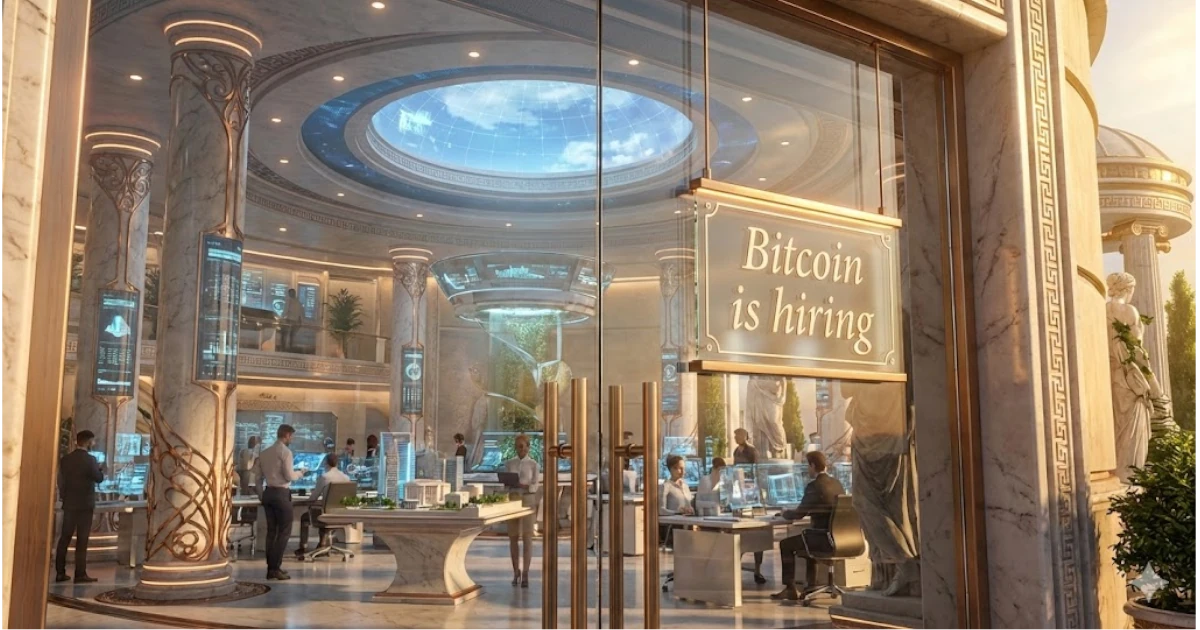
Bitcoin Magazine US Dominates Bitcoin Hiring in 2025 as Singapore Jumps 158%, Bitvocation Data Shows Bitvocation’s 2025 Bitcoin jobs report has just been released, and it shows continuing growth for the industry, as non-developer roles gain steam and Bitcoin-only companies grow 5% to become 47% of the broader crypto job market. Bitvocation is a jobs board and resources platform for the Bitcoin job market. They offer a highly curated feed of job offers, as well as career tips, specializing in network-driven hiring. They look to help Bitcoin startups as well as larger companies in the industry. According to a press release shared with Bitcoin Magazine, Bitvocation is not a recruitment agency. “We don’t headhunt. We are building a “strategic Bitcoiners reserve” to make hiring more efficient and help startups find the right talent faster.” The 2025 jobs report shows a variety of interesting trends in the Bitcoin and broader crypto industry. Bitvocation counts a total of 1,801 jobs; 6% more than 2024’s 1,707 jobs report findings. Bitcoin-only companies grew 5% from 2024, vs 53% of Bitcoin-adjacent jobs. They sort Bitcoin-only vs Bitcoin-adjacent companies based on the following criteria: Bitcoin-only products – Core offerings are exclusively focused on Bitcoin, not competing cryptocurrencies. Publicly stated commitment – The company explicitly identifies as Bitcoin-only or Bitcoin-first in its mission or communications. Ecosystem contribution – Active involvement in Bitcoin development, open-source projects, or the Bitcoin community. Most surprisingly, non-developer jobs grew 74%! Making a strong statement, you don’t need to be a developer to work in Bitcoin. Media, design, marketing, education, and operations dominate job openings among Bitcoin-only companies. 663 of the 1801 jobs are for mid-seniority positions, though jobs span the full range of seniority, providing opportunities to a wide range of applicants. When it comes to location, the United States remains the undisputed center of the industry, though every continent offers opportunities, with Singapore seeing growth of 158% from the previous year, taking second place globally. Remote jobs shrunk slightly, losing 10% to 2024 numbers. Nevertheless, almost half of all jobs in the report are remote jobs with Bitcoin-only companies offering 56% of all remote opportunities. The hardest roles to fill, according to a survey conducted by Bitvocation, are two-fold. Highly specialized technical positions, such as Bitcoin Core, Lightning, and security-related engineers, are difficult to hire for. Non-technical roles that require translating Bitcoin’s values into product, growth, operations, or communication are also presenting a challenge to employers. The survey also shows employers are looking for candidates with “Bitcoin conviction” as much as technical skills, and most of all “agency”. Strong communication, ownership mindset, and “the ability to operate in small, fast-moving teams” mattered as much as technical skill, according to the report. AI literacy is increasingly expected, but rarely sufficient on its own. Across the board, employers emphasized culture fit, such as “Bitcoin alignment” and “proof-of-work”, which generally means portfolios of projects or general contributions to the industry are more important than traditional credentials alone. Job seekers, on the other hand, reported often feeling ghosted – the solution, according to Bitvocation, is to “relentlessly build your network and create opportunities through relationships, rather than job boards”. Interest in Bitcoin jobs nevertheless remains strong. Bitvocation registered “100% growth in subscribers,” looking for Bitcoin jobs, and over 800,000 views in the Telegram feed, according to the report. This post US Dominates Bitcoin Hiring in 2025 as Singapore Jumps 158%, Bitvocation Data Shows first appeared on Bitcoin Magazine and is written by Juan Galt.

Cover image for Os sacis da nossa infância

Os sacis da nossa infância

Cover image for Will Bitcoin Price Defy Diminishing Returns This Cycle?

Will Bitcoin Price Defy Diminishing Returns This Cycle?

Bitcoin Magazine Will Bitcoin Price Defy Diminishing Returns This Cycle? Every bitcoin price bull market to date has followed a familiar pattern of explosive upside followed by sharp drawdowns, with each cycle delivering lower percentage gains than the last. This phenomenon, known as diminishing returns, has become one of the most persistent narratives in Bitcoin. The question now is whether this cycle will follow the same trajectory or if the maturation of Bitcoin as an asset class could bend the pattern. Bitcoin Price and Diminishing Returns So far this cycle, we have witnessed approximately 630% BTC Growth Since Cycle Low to the most recent all-time high. That compares to more than 2,000% in the previous bull market. To match the last cycle’s magnitude, Bitcoin would need to reach around $327,000, a stretch that looks increasingly unlikely. Figure 1: Cycle-over-cycle returns show declining multiples, but still strong absolute gains. View Live Chart Evolving Bitcoin Price Dynamics One reason for the less explosive upside gains can be seen in the Supply Adjusted Coin Days Destroyed (CDD) metric, which tracks the velocity of older coins moving on-chain. In past cycles, such as the 2021 bull market, long-term holders tended to sell after Bitcoin had already appreciated ~4x from its local lows. However, in this cycle, similar levels of profit-taking have occurred after just 2x moves. More recently, spikes in CDD have been triggered by even smaller price increases of 30–50%. This reflects a maturing investor base: long-term holders are more willing to realize gains earlier, which dampens parabolic advances and smooths out the market structure. Figure 2: Supply-adjusted CDD highlights how profit-taking occurs at lower multiples each cycle. View Live Chart Another factor is Bitcoin Volatility. Bitcoin’s quarterly volatility has trended steadily lower. While this reduces the odds of extreme blow-off tops, it also supports a healthier long-term investment profile. Lower volatility means the capital inflows required to move price grow larger, but it also makes Bitcoin more attractive to institutions seeking risk-adjusted exposure. Figure 3: Bitcoin’s volatility is declining, but risk-adjusted returns remain stronger than equities. View Live Chart This shows up in the Bitcoin Sharpe Ratio, where Bitcoin currently scores more than double that of the Dow Jones Industrial Average. In other words, Bitcoin still offers superior returns relative to its risk, even as the market stabilizes. Figure 4: Bitcoin’s Sharpe ratio is twice as high as the Dow Jones’s. View Live Chart Bitcoin Price and the Golden Ratio From a technical perspective, The Golden Ratio Multiplier provides a framework for projecting diminishing returns. Each cycle top has aligned with progressively lower Fibonacci multiples of the 350-day moving average. In 2013, price reached the 21x band. For the 2017 top, it reached the 5x band, and in 2021, the 3x band. This cycle, Bitcoin has so far tagged the 2x and 1.6x bands, but a push back toward the 2x levels remains possible. Figure 5: Applying The Golden Ratio Multiplier to illustrate diminishing BTC returns. View Live Chart Projecting these 1.6x and 2x levels forward, based on their current trajectory, suggests a target between $175,000 and $220,000 before the end of the year. Of course, the data won’t play out exactly like this, as we would see the 350DMA move more exponentially to the upside as we closed in on these upper targets. The point is these levels are ever-changing and constantly pointing towards higher targets as the bull cycle progresses. Figure 6: The Golden Ratio Multiplier framework suggests upside to $175k–$220k. Bitcoin Price in a New Era Diminishing returns don’t reduce Bitcoin’s attractiveness; if anything, they enhance it for institutions. Less violent drawdowns, potentially lengthening cycles, and stronger risk-adjusted performance all contribute to making Bitcoin a more investable asset. However, even as Bitcoin matures, its upside remains extraordinary compared to traditional markets. The days of 2,000%+ cycles may be behind us, but the era of Bitcoin as a mainstream, institutionally held asset is only just beginning, and will likely still provide unmatched returns in the coming years. For deeper data, charts, and professional insights into bitcoin price trends, visit BitcoinMagazinePro.com. Subscribe to Bitcoin Magazine Pro on YouTube for more expert market insights and analysis! WATCH BITCOIN VIDEO ANALYSIS Disclaimer: This article is for informational purposes only and should not be considered financial advice. Always do your own research before making any investment decisions. This post Will Bitcoin Price Defy Diminishing Returns This Cycle? first appeared on Bitcoin Magazine and is written by Matt Crosby.

Return to Homepage