Legacy of Resistance: The Life and Art of Naji Al-Ali
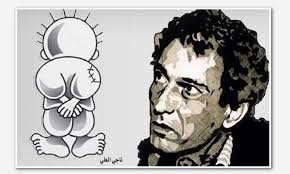
Naji Al-Ali was a Palestinian caricaturist, known for his revolutionary spirit depicted through his cartoons addressing political issues concerning Palestine and the broader Arab world. He worked for various Arab newspapers in Kuwait, London, and Lebanon. His drawings, notably featuring the character Handala and other figures, gained widespread recognition.

Throughout his career, Naji Al-Ali created around forty thousand cartoons. In 1978, he was awarded the Golden Pen of Freedom by the International Federation of Journalists. Tragically, he was assassinated in London in 1987.

Naji Salim Hussein Al-Ali was born in the village of Al-Shajara, Palestine, around 1937. At age ten, he moved with his family to Lebanon and settled in the Ein el-Hilweh refugee camp after the Israeli occupation of Palestine in 1948. Despite facing imprisonment by Israeli forces and the Lebanese army for his anti-occupation activities, he continued his artistic journey, often drawing on prison walls.

He couldn’t complete formal education due to difficult circumstances but later studied mechanics and then pursued art at the Lebanese Academy in 1960. His breakthrough came when writer Ghassan Kanafani noticed his work in Ein el-Hilweh, leading to publications and recognition.

Naji Al-Ali’s iconic character, Handala, first appeared in 1969 in the Kuwaiti newspaper Al-Siyasa. Handala, a ten-year-old Palestinian boy with his back turned and hands clasped behind his back, became a symbol of Palestinian steadfastness and defiance against injustice.

Naji Al-Ali’s work extended beyond Handala to include characters like Fatima, symbolizing unwavering determination, and other symbolic figures critiquing Palestinian and Arab leaderships, as well as Israeli policies.

He published three books compiling his most significant cartoons and received numerous awards, including first place at the Arab Cartoon Exhibition in Damascus in 1979 and 1980.

Naji Al-Ali’s assassination in London in 1987 remains unsolved, with speculation implicating Israeli Mossad or Palestinian factions due to his outspoken criticism of both.

He was laid to rest in the Brookwood Islamic Cemetery in London, despite his wish to be buried in Ein el-Hilweh next to his father, reflecting the challenges and controversies that marked his life and legacy.


Write a comment