Federal Revenue Service to extend IR on Bitcoin and other cryptocurrencies from 2026

The Lula government’s hunger for more taxes continues and now the new measure to achieve this will be to income tax on cryptocurrency earnings in 2026. With the new measure, the table, which used to be progressive, will be replaced by a single rate of 17.5%. This means, in practice, higher income tax for most investors.
In addition to the expansion of income tax on cryptocurrencies, the inspection will include assets in self-custody, DeFi operations and foreign investors. The Lula government and the RF want to ensure that no one escapes taxation. Another change is the end of the current exemption of R$35,000 per month. Crypto-assets held in custody abroad are also taxed, regardless of their value, at a rate of 15%.
In addition to the expansion of income tax on cryptocurrencies, the inspection will include assets in self-custody, DeFi operations and foreign investors. The Lula government and the RF want to ensure that no one escapes taxation. Another change is the end of the current exemption of R$35,000 per month. Crypto-assets held in custody abroad are also taxed, regardless of their value, at a rate of 15%.
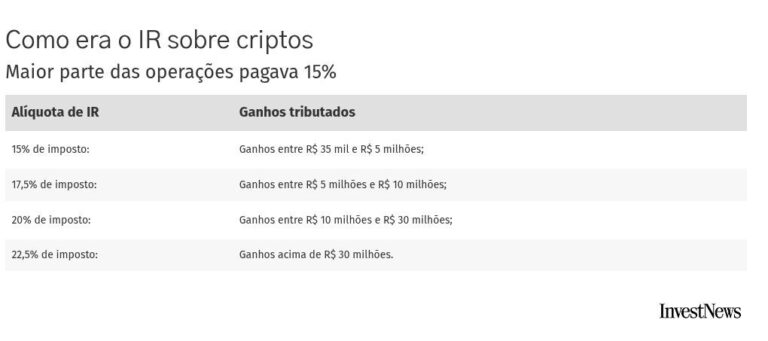
As already mentioned, the new measure, provided for in Provisional Measure No. 1,303, will expand inspection to include assets in self-custody, DeFi operations and foreign investors. In addition to restricting the offsetting of losses only within the crypto market, the government has also determined that companies must include gains from digital assets in the calculation of IRPJ and CSLL.
As justification for this new measure, the Ministry of Finance stated that the new rule seeks to eliminate tax loopholes and balance taxation in relation to other investments, reinforcing the adjustment of public accounts for 2025 and 2026. The reality is that the Lula government is desperate for new sources of taxes, since everything that has been taxed so far has not been enough to cover its unbridled spending on perks, welfare and buying support in Congress.
And in the end, as always, the tax payers cynically called “taxpayers” by the state will pay for it all.
Perhaps with this new measure many cryptocurrency users will wake up to the risks of keeping their coins in centralized exchanges and opt for self-custody using more advanced privacy techniques (see this ) and opt for P2P platforms for cryptocurrency trading, such as .

Write a comment