Joseph Smith and Muhammad
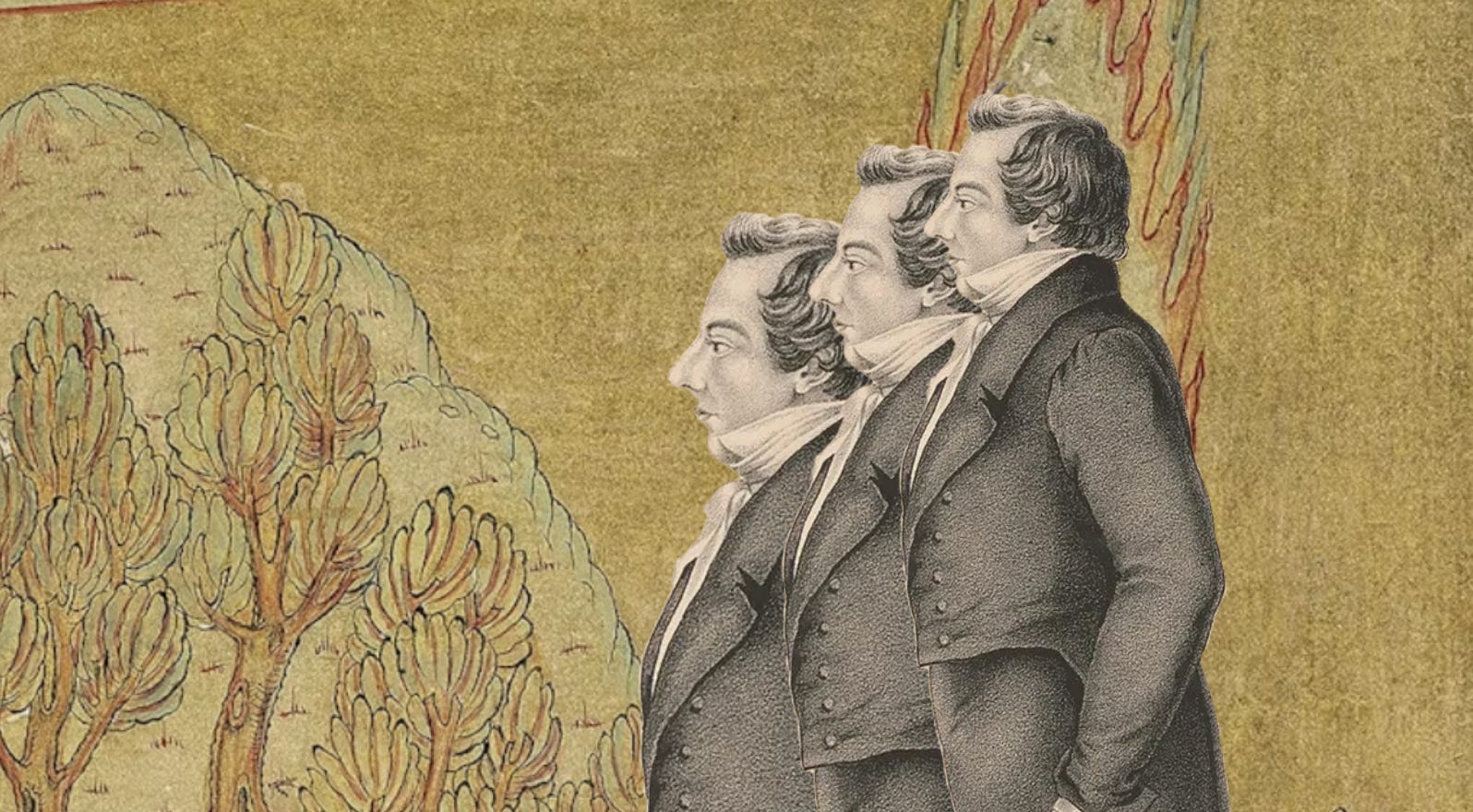
Source: Joseph Smith and Muhammad Publisher: Kyle Beshears | Author: Kyle Beshears Published: May 29, 2026 | Archived: May 30, 2026

“It is generally acknowledged that Mormonism is similar to Mohammedanism MATHPH0XEND in its endorsement of the practice of polygamy, and its ideas of heaven. Many other points of similarity between these systems have been noted by students, and the Book of Mormon has marked resemblance to the Koran. As all ancient religions have a modern equivalent, Mormonism can justly be claimed to be the modern form of Mohammedanism, and not incorrectly termed ‘the Islam of America.’”
— Foreword to Bruce Kinney’s “*Mormonism: The Islam of America”* (1912)
What if I told you there was a man who claimed God called him to be a prophet.
The religious context around him, he’d have said later in life, was a mess. But God was doing something different, a new thing—and it would be brought about exclusively through him. There’d be signs, of course. He’d commune with angels, and he’d prophesy. His was an example to follow, people would later say. Well, not entirely. He’d not be without his faults—this man found that a single wife was insufficient, and so he entered into polygamy.
What would you say about a man like that?
Would you believe his claims?
I do.
Abraham is among my favorite men in the Hebrew Bible. His story is messy, and it’s meant to be. I think he sinned in taking on an additional wife, but I believe he communed with angels, was a prophet of God, and the progenitor of the people through whom the messiah came.
What I don’t think Abraham anticipated, though, was just how many men throughout history would come to mimic his life.
In the seventh century, another man claimed much the same. The religious world around him was a mess, he’d have said, crowded with idols and the broken remnants of older faiths. But God was doing something new through him, and through him alone. There were signs, of course. An angel, *Jibreel*, came to him with words to recite, and he prophesied, too. He also found one wife insufficient, and took others. This was Muhammad.
Hear the rhyming?
Christians throughout history have pointed to Muhammad as the archetypal false prophet, and to his religion, Islam, a false one. He didn’t just mimic Father Abraham. He supplanted Abraham’s offspring, the messiah, Jesus Christ, claiming the place of God’s greatest prophet for himself. And he produced new scripture, the Qur’an, that he held to be superior to the corrupted books that came before.
Martin Luther, for example, lumped the papacy and Islam together as twin idolatries. He believed the pope was Antichrist and the Turk was the devil, and he wrote a children’s hymn so the next generation would learn to sing against both at once.
s_!qIvm!,w_1456,c_limit,f_auto,q_auto:good,fl_progressive:steep/https%3A%2F%2Fsubstack-post-media.s3.amazonaws.com%2Fpublic%2Fimages%2Fc1351ce8-eddd-45a6-afb1-e086c2686ef8_1300x1751.png) Image from Reformer Johann Ulrich Wallich (d. 1673), depicting the Papal Crown and Ottoman Sultan’s Turban “joined into a circle.”
Image from Reformer Johann Ulrich Wallich (d. 1673), depicting the Papal Crown and Ottoman Sultan’s Turban “joined into a circle.”
John Calvin followed Luther on this. He declared that the Qur’an was to the Muslim what papal decrees were to the Catholic. They were, as he put it, the two horns of Antichrist.
Protestants “seized on Islam as a weapon against Catholicism,” noted one scholar, and then “also used Islam to critique intra-Protestant divisions,” especially heresies within their movement, like the Socinians.
For their part, theologians of the Catholic Counter-Reformation returned the favor. Robert Bellarmine argued that the Reformers had unwittingly taken their cues from Islam. Both Muhammad and the Reformers, he said, had rejected the rule of faith that preceded them in order to concoct an aberrant reading of Christian scripture, and the result in both cases was a new religion.

*“The imposture Mahomet” in hell, along with the “seducer” John Calvin (1687).*
The tactic was a two-way street: Catholic vs. Protestant, Protestant vs. Catholic, and never with much evidence on either side, because evidence wasn’t the point.
John Tolan, in *Faces of Muhammad*, shows how the prophet of Islam has been read through a Western lens in every age. What interests me is how he functions as a kind of Rorschach test. He’s evil or exemplary depending on whichever opponent you want to associate him with. When Christians need a malignant archetype to compare their enemies to, he’s the villain. When French Enlightenment elites want to tear down the Catholic Church, they hold him up as a reformer. Even Napoleon, who admired him as a statesman, viewed Muhammad’s epileptic fits—commonly interpreted as a sign of demonic possession—as evidence of his humanity, since Caesar suffered the same affliction.
Muhammad becomes whatever the moment requires, but for Christians he’s almost always a negative example.
I spent time during my doctoral studies in religion working through the history of this rhetorical move, which I came to call “**Islamic calumny**”: ***the libelous association of a non-Muslim opponent with Islam or Muhammad in order to damage their reputation.*** The Dutch scholar Christiaan Snouck Hurgronje was, so far as I can tell, the first to notice the pattern. In 1916, he coined the awkward term “cryptomohammedanism,” so I prefer Islamic calumny.
It comes in two strengths.
The *weak form* insinuates that someone resembles Muhammad or his religion by parallel. The *strong form* directly accuses them of being a secret Muslim. If you recall, Donald Trump made it a habit, years ago, of suggesting that Barack Obama was secretly a Muslim. That’s a classic example of the strong form.
I stumbled across the weak form just a few days ago, when an popular **[interview clip](https://x.com/RealMattFradd/status/2059378963198222771)** made the rounds. In it, the host and guest, a Christian apologist, compare Joseph Smith to Muhammad, and in doing so they joined, perhaps unwittingly, a long line of Christians who’ve made the same move for generations.
### *Joseph Smith, the “Yankee Mohamet”*
By the time Bruce Kinney published *Mormonism: The Islam of America* in 1912—quoted at the top of this essay—the idea had so permeated the American imagination that the foreword I quoted treated the parallel as common knowledge rather than a claim that needed any defense.
There’s no need to prove the parallel, because everyone already knew.
A century later, the argument is still being made the same way. The **[interview clip](https://x.com/RealMattFradd/status/2059378963198222771)** works because the audience already dislikes Muhammad enough that comparing Joseph Smith to him is sufficient as a condemnation.
This maneuver usually rests on a surface trio of red flags—prophet, angel (Jibreel/Moroni), and polygamy—but falls apart the moment you apply sustained pressure. Muhammad subordinated Jesus to himself, but Joseph kept Jesus at the center of his system, whether it was the Book of Mormon, D&C 76, temple rituals. Whatever else can be said about Joseph’s theology—and there’s plenty—he didn’t demote Jesus to make room for himself. Indeed, if I were a betting man, I’d say Muhammad would have found Joseph to be guilt of the sin of *shirk*.
Mine isn’t a new observation. [Writing in](https://www.dialoguejournal.com/wp-content/uploads/sbi/articles/Dialogue_V06N01_48.pdf) *[Dialogue](https://www.dialoguejournal.com/wp-content/uploads/sbi/articles/Dialogue_V06N01_48.pdf)* back in 1971, Arnold H. Green and Lawrence P. Goldrup argued, rather bluntly, that the Islam-Mormonism comparison *obscures* more than it reveals. Two out of every three points of similarity turn out to be either untrue or oversimplified, and the analogy itself is an oversimplification. We run the risk of “parallelomania,” the term Samuel Sandmel coined in 1962 for exactly this kind of overreach.[1](#footnote-1)
For me, though, it’s striking just how *unoriginal* the comparison is.
Joseph’s earliest critics were anything but subtle about using it. Abner Cole called Smith “the imposter of Mecca,” adding that “no mandate of Mohamet was ever more implicitly obeyed” than Smith’s commands among his followers.[2](#footnote-2) From there, it became a standard move. Eber D. Howe lumped Smith into a category of false messiahs led by “Mahomet, who is considered the prince of impostors.”[3](#footnote-3) Anti-Mormon polemicists dubbed Smith the “New York Mahomet,” the “American Mahomet,” the “Yankee Mahomet.” By 1854, one book embedded it into the title—*Memoirs of the Life and Death of Joseph Smith, the American Mohamet*. In 1912, Bruce Kinney published *Mormonism: The Islam of America*.[4](#footnote-4) I could go on and on.
s_!zGtt!,w_1456,c_limit,f_auto,q_auto:good,fl_progressive:steep/https%3A%2F%2Fsubstack-post-media.s3.amazonaws.com%2Fpublic%2Fimages%2F93120b96-0b91-45ad-a3f4-c3f49fbb11e9_464x294.png) New York Daily Herald, Fri, Jun 17, 1842
New York Daily Herald, Fri, Jun 17, 1842
Here’s what I found really interesting when I worked through these books for my research: all of them promised a comparison, but never deliver one. The Muhammad analogy is in the title and sometimes the preface, but after that, the text just goes about its business of attacking Joseph for the same handful of reasons every anti-Mormon book of that era attacked him, e.g., the Spaulding-Rigdon theory of the Book of Mormon, polygamy, Smith’s character, etc. The Muhammad comparison was front-loaded but rarely materialized in the books.
And, yet, it still landed with readers.
Why?
Here was my conclusion:
Comparing Joseph Smith to Muhammad functioned—as it still functions—by borrowing the reader’s existing distaste for one figure and applying it to another without needing to actually defend the parallel.
It relies more on a person’s dislike of Muhammad than Joseph’s similarities with him.
The reason it can’t definitively deliver a verdict is because it can’t sustain the argument it promises and instead hopes you’ll not ask many questions. Once you get past prophet, angels, and polygamy, the comparison soon runs out of road. The apologist has to keep retreating to vaguer and vaguer ground. They start talking about charisma, then about deceived followers. Eventually—as the gentleman in the video does—they start talking about demons.
That last move is the final tell, when the whole thing transmutes from a comparison to an exorcism. The argument isn’t about Joseph Smith or Muhammad anymore; rather, it’s now about the speaker’s need to toss both of them to the same theological trashcan.
Now, to be clear, the one thing Joseph Smith and Muhammad do have in common for me is that neither was a prophet. Saying so plainly is honest conviction—I’d be a Latter-day Saint or Muslim, otherwise—and it’s a different act from the calumny I’ve been describing. But, if we’re not careful, this sort of thing can drift into bearing false witness and slander.
Remember, the assumption of Islamic calumny is that your audience holds negative views toward Muhammad and Islam, and maybe even Muslims themselves. There’s a reason the apologist in the interview can’t make the argument in, say, Muslim-majority Indonesia. The whole rhetorical maneuver follows contempt. Strip out the contempt, and the comparison loses much of its force. So, what sounds like an argument in America would sound like an insult in Jakarta, and an unintelligible one at that.
I think that’s a missiological observation that gets tossed aside when the Joseph-Muhammad comparison is made. The comparison only works in front of audiences who already despise the comparison’s other half, so, to be frank, it’s not really an argument—it’s a shibboleth. It doesn’t persuade anyone who needs persuading, and it risks slandering people who aren’t part of the tribe.
A Better Comparison
So, I want to recommend something better—the only comparison I think is worth making.
The real parallel between Muhammad and Joseph isn’t prophet + angels + polygamy. It’s that both men were reacting against a version of Christianity they did not fully understand, and both built a new revelation on top of a misdiagnosis.
Consider Muhammad first. The Qur’an’s picture of the Trinity isn’t the Nicene confession. In Surah Al-Ma’idah (5), Allah asks Jesus whether he told people to take him and his mother as gods alongside Allah. The most defensible reading is that the verse rebukes excessive Marian devotion, so the Qur’an’s picture of Christian belief was confused about Mary’s status and never engaged the Nicene confession on its own terms. Whether this reflects direct contact with a Collyridian sect or a more general confusion about Marian devotion among Arabian Christians is debated. My point, here, holds either way. Muhammad was reacting to a caricature of Christianity rather than to the faith Christians actually confess. His new revelation answered a problem the church never actually had.
Now for Joseph Smith. The founding narrative of the Mormons, as a restoration movement, depends on the Great Apostasy. In the First Vision account, Joseph reports being told that all the existing churches were corrupt, and that their creeds were an abomination. The premise of Mormonism is this diagnosis. Joseph said the keystone of the religion is the Book of Mormon, but, without the Great Apostasy, there’d be no need for the Book of Mormon. It’s why the First Vision precedes Moroni.
If the authority and power of the church the Lord Jesus founded didn’t waned and eventually vanish from the earth, then there’s nothing to restore, only to reform or renew. But Joseph encountered frontier American Protestantism in its most fractured and revivalist form, drew the conclusion that the original church had been lost, and then built a new dispensation on the diagnosis.
But his diagnosis was wrong. The power and authority of the ancient church didn’t vanish. The creeds weren’t corruptions but careful clarifications worked out by men trying to be faithful to what the apostles handed down. Like Muhammad, Joseph was reacting to a version of Christianity that orthodox Christians don’t actually recognize.
So, consider that both men encountered Christianity in a distressed state, and then both drew incorrect conclusions about what orthodox Christianity actually taught. This led both men to produce—sincerely, I believe—new revelations to fix problems that weren’t really there.
In Muhammad’s case, the misdiagnosis was Christological and Trinitarian. In Joseph’s case, the misdiagnosis was ecclesiological and scriptural. The patient wasn’t as sick as either physician believed, and the cure each prescribed was worse than the disease they thought they saw, since it fractured Christianity even further.
I find this lone Smith-Muhammad comparison helpful for two reasons.
First, it treats both men as sincere religious actors rather than as cynical frauds or demonic puppets. This is consonant with what I believe about Joseph’s motivation as a sincere actor, although I don’t find his sincerity a measure of veracity. He wasn’t a conscious liar; rather, he genuinely believed he was recovering something ancient and lost. The same charity, extended to Muhammad, suggests a man trying to call his people away from idolatry toward the worship of one God, working with the materials at hand, which included a distorted picture of the Christian faith. One can be wrong without being wicked.
Second, it puts the conversation on better ground. Islamic calumny was never going to persuade a Latter-day Saint of anything except that the speaker hadn’t done the homework. I think my misdiagnosis framing actually opens a door because it asks a better question: “What did the NT church teach, and did its power and authority ever disappear?” If we can talk about that, then we can talk about whether Joseph had anything to restore in the first place. And, as a bonus, we can talk about it without relying on prejudice.
There’s a place for sharp arguments against Joseph Smith’s prophetic claims. In my opinion, the historic Christian witness against the Great Apostasy thesis is among the sharpest available. But it doesn’t require a low and lazy comparison maneuver that depends on an audience already disliking Islam.
At any rate, I think the Smith-Muhammad comparison yields as many similarities as it does differences, and so loses whatever force it pretends to carry. A measure that returns a match and a mismatch on every point isn’t measuring anything. Indeed, if we’re honest, it acts more like a mirror the apologist holds up mostly to see his own contempt looking back.
So, set the mirror down. The question worth our time was never whether Joseph rhymes with Muhammad. It’s whether the church Jesus founded ever lost the authority Joseph said it lost. Put that question to a man you take to be sincere, and you’ve traded a lazy slur for an argument that’s worth discussing.

s_!e27c!,w_1456,c_limit,f_auto,q_auto:good,fl_progressive:steep/https%3A%2F%2Fsubstack-post-media.s3.amazonaws.com%2Fpublic%2Fimages%2F6fe9a81a-6fbf-42d6-8446-639063a5617b_1500x1150.png)
📘 Out Now! 40 Questions About Mormonism**
If you’ve appreciated this essay, you’ll love 40 Questions About Mormonism (Kregel Academic). It’s written for traditional Christians who want clear, charitable, and biblically faithful answers to the most common questions about the Latter-day Saint faith and tradition.
ORDER TODAY** and download three free chapters**.
Samuel Sandmel, “Parallelomania,” Journal of Biblical Literature 81, no.1: 1-13.
“Gold, Bible No. 2.,” The Reflector (Palmyra, NY), January 18, 1831.
Eber D. Howe, Mormonism Unvailed, ed. Dan Vogel (Signature, 2015), 193 \[originally 131\].
See Harold H. Green, “Mormonism and Islam: From Polemics to Mutual Respect and Cooperation,” BYU Studies 40, no. 4:199–220.


Write a comment