I'm a Data Scientist. I Analyzed the ENTIRE Book of Mormon.
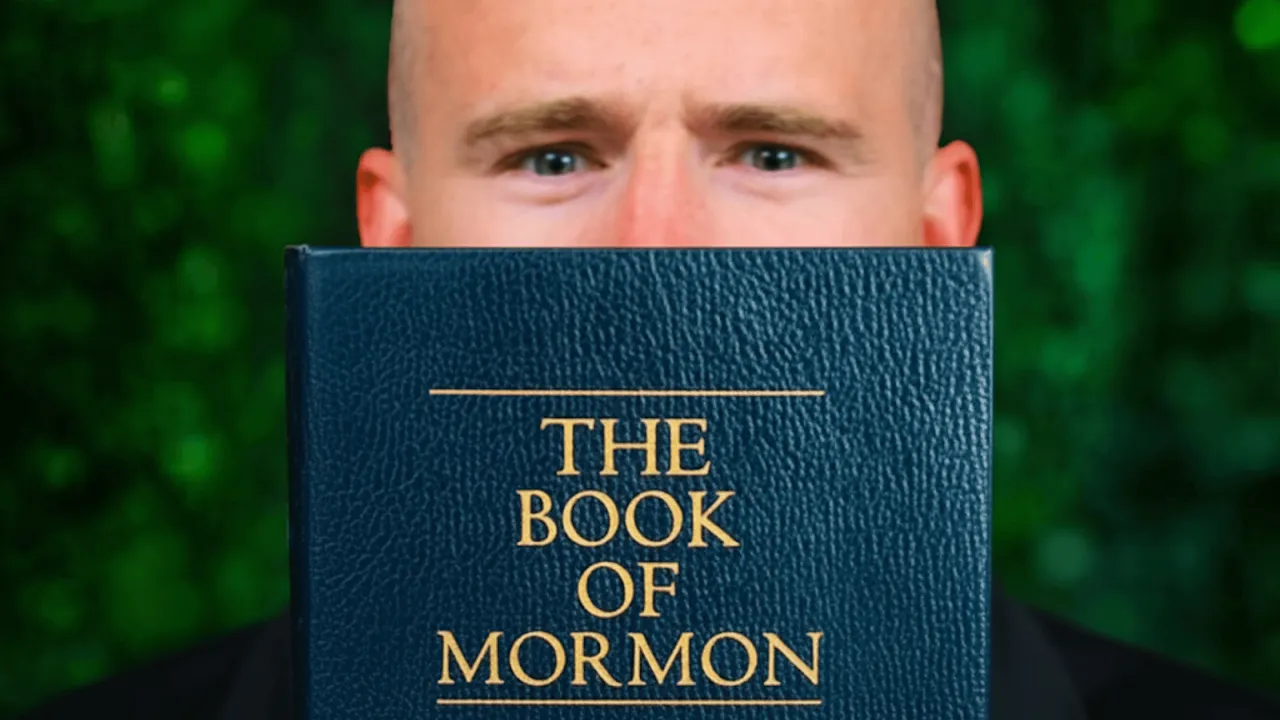
Source: I’m a Data Scientist. I Analyzed the ENTIRE Book of Mormon. Channel: The Bald Coder Published: September 28, 2025 | Archived: May 24, 2026
Video: I’m a Data Scientist. I Analyzed the ENTIRE Book of Mormon.
Channel: The Bald Coder
Published: September 28, 2025
Duration: 8:56
Views: 337,509
Category: Science & Technology
Video ID: iHc1YDraCWs
Description
What happens when you give one of the most controversial religious texts to a machine?
I built a Python script that analyzes every chapter of the Book of Mormon—scoring it on how Christ-centered, moral, and dignified the text really is.
We compare it to the Bible, visualize the data, and even test it against Jesus’s own words in Matthew 7: “By their fruits ye shall know them.” Is the Book of Mormon a good fruit?
This video is part scripture analysis, part data science, and part existential dread. Whether you’re a lifelong Latter-day Saint, an exmo, a curious outsider, or someone who just really likes graphs, this one’s for you
#bookofmormon #churchofjesuschrist #mormon #exmormon #coding #datascience #programminglanguage Learn to code with Scrimba (https://scrimba.com/?via=thebaldcoder). Save 20% with my link!
Transcript — YouTube panel (human-authored)
0:00 I have behind me on my desk one of the most controversial religious texts of all time. This is the Book of Mormon, another testament of Jesus Christ. And there are a lot of mixed opinions about this book. Here are three facts that made me, a lifelong Mormon, realize the Book of Mormon is a madeup fantasy book. There are well over a 100red accounts from 19 separate eyewitnesses to the Book of Mormon plates. Did any of the witnesses of Joseph Smith’s golden plates ever renounce their testimony?
0:25 Some sources say they did. Alex, if you had to join one Christian denomination, which do you believe has the most consistency according to the history of the church in scripture? Mormonism, of course. Oh my gosh. Now, I’m not going to hold this book in frame for the entire video because I don’t have a mic stand, but it’ll be right here behind me for this entire video. Now, why is this book so controversial? Because it has a pretty insane origin with some pretty insane implications. This book was claimed to be delivered by an angel to a young prophet named Joseph Smith. And the book talks about an ancient American people that had faith in Jesus Christ before he was born. And this book even claims that Jesus Christ himself visited these people after he was resurrected.
1:02 Basically, if this book is true, this means that Joseph Smith actually was a prophet, the Book of Mormon, is actually the word of God, and that the church that he founded, the Church of Jesus Christ of Latter-day Saints, is God’s church on Earth today. But if this book isn’t true, this means that 17 million people are currently being spiritually catfished. Joseph Smith was a fraud, and the Book of Mormon is not the word of God. And honestly, both of these options are pretty insane. And so recently, you can imagine I was very intrigued when I saw this video show up on my YouTube algorithm. I’m an atheist. I read the entire Book of Mormon. And I watched that video and I was very intrigued. I don’t remember the channel name, but the guy that did this video was very well produced and he had a lot of interesting comments. And so after watching that video, I realized that there’s something that I could do to add something to this Book of Mormon conversation, \[music\] and
1:41 it’s to do a data analysis of the entire Book of Mormon. And so, a little known fact about me, I actually have my master’s degree from a Christian university in data science. And something that I learned at this university is text can be used as data. And we can actually use a process called natural language processing to give a little bit more objectivity to things that are usually subjective. Like for example, if we go on Amazon and we were to look at reviews, the onestar reviews, a lot of people would assume that one star reviews \[music\] have more negative words and five star reviews have more positive words just by the vibe of the reviews. But using this data analysis technique, we are actually able to give an objective score to how positive or negative \[music\] words in a sentence are. This is called sentiment analysis.
2:17 So yeah, it’s true. The one-star reviews generally have more negative words and fivestar reviews generally have more positive \[music\] words objectively. And so I realized we can use the same concept but in a spiritual context. I can take the entire Book of Mormon and I can use natural language processing to analyze the entire book not just on how positive or negative the words are. We can choose literally \[music\] anything that we want. We can analyze how Christc centered the text is. We can analyze how dignified the language is. We can literally do anything. And so there’s two different ways I want to analyze the Book of Mormon. I want to analyze it from a Christian perspective and from a non-religious perspective. First of all, the Christian’s perspective. I want to use Jesus’s own words as the measuring stick for this analysis. In Matthew 7, he said, “Beware of false prophets.” And so, we want to know if Joseph Smith was
2:58 a false prophet. And so, this is the test that he gives us to see if someone’s a fake prophet or a real prophet. Every tree brings forth fruit. A good tree cannot bring forth evil fruit. Neither can a corrupt tree bring forth good fruit. And so, by their fruits, you will know them. And so, on the Christian analysis, I want to use this as a baseline. How much does the Book of Mormon talk about Jesus Christ?
3:15 How much do the teachings of the Book of Mormon align with biblical teachings? And does this book make you want to get closer or further away from Jesus Christ? And so, the analysis is going to give an objective score from 1 to 10 based on how Christ-c centered it is. One being not Christc centered, 10 being extremely Christc centered. Now, this analysis doesn’t really mean anything if we don’t have anything to compare it to.
3:31 So, I’m going to run this exact same analysis on the Bible as well. And we can see how Christc centered the Book of Mormon is compared to the Bible. And so, it’s going to go through every single chapter of the Book of Mormon and every single chapter of the Bible and give each chapter a score. And now for the non-religious perspective, I just want to know if it’s an ethical book regardless of what your religious beliefs are or not. Does this book invite you to live a good, moral, ethical life? And so the analysis is also going to give a similar score of 1 to 10. One being not ethical at all, 10 being extremely ethical. But now that we know exactly what we’re going to do, let’s go ahead and run the analysis. Okay, so we are looking at the code now.
4:00 So I can show you just a little bit about what I actually did to do this analysis. I’ll just show you the end result just so you can understand what it’s doing. So it outputed a JSON file for every chapter of the Bible. And right now we’re in the book of Matthew. And so we’re in chapter 1. And it output for us, like I said, a Christ-c centered score of 10 and a moral score of nine. I also had to output and summarize the invitations of each chapter along with a rationalization for why it gave each of these scores. I did the same thing for every book of the Book of Mormon and also the Old Testament. So let’s actually go into the code now and see what it’s doing. So like I mentioned before, we are using the Gemini API.
4:30 That’s just because the Gemini API has a really good free tier. But this is how the scores are actually being made. So we organize it by the text, the book name, and the chapter number. And then this is the system prompt that we use. Analyze the following chapter from the data from before and then on a scale of 1 to 10, how Christ centered is this chapter? Consider direct mentions of Jesus Christ, references to Christ’s teachings, emphasis on Christian doctrines and principles, and the focus on Christ’s role in salvation and eternal life. One is not Christc centered at all. 10 is extremely Christ-c centered. And the same thing here for the morality score function. We feed in the same data and then it returns a score of 1 to 10 based on morality. So this one considers promotion of virtues, condemnation of vices, encouragement of ethical behavior, messages of justice, mercy, and human dignity, and treatment of others with respect and kindness. And
5:11 same thing as before, it’ll return a score of one if it’s highly immoral or 10 if it’s extremely moral. And so it goes through all the books in the Bible in the Book of Mormon. And then finally, we have this main function. This function basically runs everything above it, and it runs the code until we’ve gone through every chapter of all the books. So it’s about 300 lines of code, and I think it’s pretty cool. Now, I initially made some graphs myself using Mattplot Lib. I made stuff like this.
5:31 But once I got all the summary statistics, what I did is I fed that data to Claude and I had it visualize the data for us just so I wouldn’t spend so much time making these visualizations. And so this is the table of the statistics. And so for the Book of Mormon for a Christ-c centered score, we had a mean of 7.89 and a standard deviation of two. And we see that 25% of all the chapters are \[music\] at least a 10 out of 10 on Christ centeredness. And 50% of the chapters are at least an 8 out of 10. Now, if we compare that with the \[music\] Bible, it has a mean of 5.11 and a higher standard deviation of 2.4.
5:59 41. 75% of its chapters have a 6.0 or higher of Christ-c centeredness and 50% have a 4.0 or higher. Now, if we look at the morality score or a non-religious perspective, the Book of Mormon has a mean \[music\] of 9.03, meaning that the morality score is higher than the Christ centered score and a standard deviation of 0.82. And that’s reflective here in the quartiles. This is crazy. Over 75% of all of the chapters have a morality score of 9.0 or higher. 75% meaning that the Book of Mormon is an extremely moral book. And compare that with the Bible.
6:28 It has a mean of 8.24 which is still really high and a standard deviation of 1.12. And we see similar trends here. 25% of the chapters have a 9.0 or higher. 50% of the chapters have an 8.0 or higher. And 75% have a 75% or higher. So both books score extremely high in moral score and they’re both high in Christ centered score, but the Book of Mormon is a bit higher on the Christc centered score compared to the Bible.
6:47 And so that’s what this visualizes right here. The Book of Mormon showing the difference with the Book of Mormon in blue and the Bible in green. But obviously this is to be expected because like most of the Bible is the Old Testament which never mentions Christ directly. And so I did break it down between Old Testament, New Testament in the Book of Mormon as well. In terms of Christ centered \[music\] score, the New Testament has a score of 9.12 which is good because it talks about the life of Jesus Christ which is higher than the Book of Mormon 7.89. In terms of moral score, the New Testament has a 9.06 and the Book of Mormon has a 9.03. So those are basically the same. And the Old Testament actually has a moral score of 8.01, which is also extremely high, but obviously a lower Christ \[music\] centered score of 3.97. Something to be aware of is that the New Testament only takes place obviously during Christ’s ministry, but the Book of Mormon claims
7:27 to take \[music\] place during 600 BC in Old Testament times all the way through 400 AD through New Testament times. And so it’s significant that the Book of Mormon is testifying of Christ from the very first chapter, while the Bible obviously does not do that into the New Testament. Now, what are my thoughts on all of this? I think it is very significant how well the Book of Mormon scores. \[music\] Compared directly with the Bible, it scores higher in all three categories. And when you break it up, it’s extremely comparable to the New Testament while spanning a broader period of time. I could even go as far as to say that I think that the Book of Mormon according to this test in Matthew chapter 7 would be classified as a \[music\] good fruit because it obviously testifies of Christ and it invites its readers to live a good moral life.
8:02 \[music\] If you want to take a look at this yourself, I’ll link to all of the resources down below. So, is this absolute proof that the Book of Mormon is the word of God? Absolutely not. This analysis was done using large language models \[music\] and large language models are trained on human biased data. And so, you should never blindly believe anything that a large language model tells you, no matter how convincing it sounds. I think the reason there’s so much \[music\] controversy around this book is because you cannot definitively say whether or not this is true or not, regardless of what technology you’re using. And the same can be said for the Bible. There are people that believe in its words and there are people that do not. But at the end of the day, the reason that people keep reading the Bible is not because of scientific discovery or a data analysis done in the Bible. It’s because people feel good when they read it and they have spiritual experiences. And the same thing can be said for the Book of
8:42 Mormon. Some people love it and some people hate it. And so if you’re curious, maybe try \[music\] to read it and see if you feel good inside. If you do, great. If not, then don’t worry about it. All right, I think that’s it. Bye.
- Reference: https://www.youtube.com/watch?v=iHc1YDraCWs


Write a comment