Autistic Barbie Was Doomed
Source: Autistic Barbie Was Doomed Publisher: Cartoons Hate Her | Author: Cartoons Hate Her Published: January 15, 2026 | Archived: March 21, 2026
Just as I’ve quiet quit Twitter, multiple people notified me that some primo CHH chum had hit the TL: there is now an autistic Barbie, and people are mad about it.
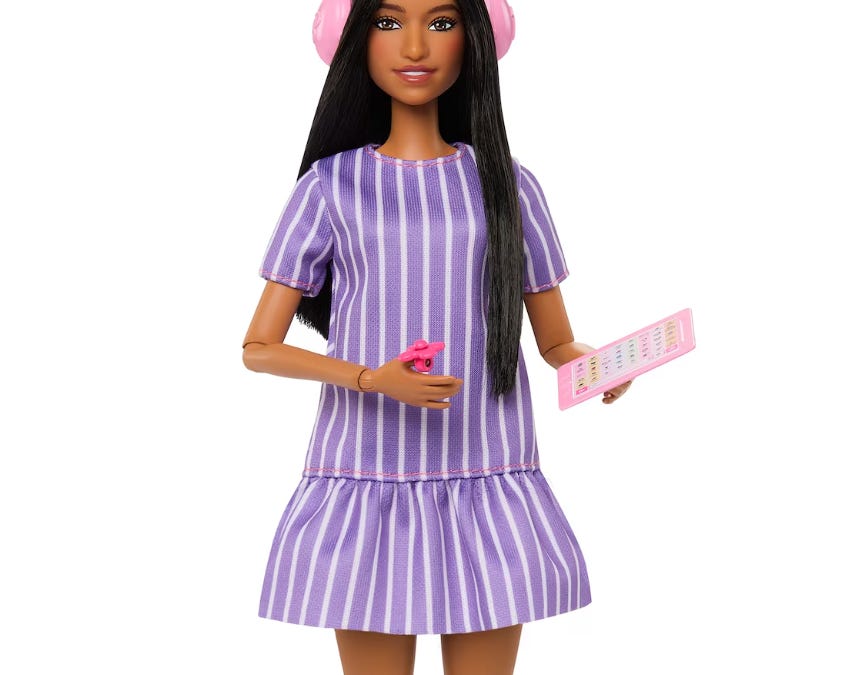
The autistic Barbie in question comes with headphones, a tablet, and a fidget spinner, adjustable arms for stimming, but otherwise basically looks like a normal Barbie. Perhaps in an abundance of caution, Mattel made her just about as racially ambiguous as possible:

According to [ABC News](https://abcnews.go.com/GMA/Living/advocacy-groups-react-after-mattel-introduces-1st-barbie/story?id=129132647), advocacy groups and parents of autistic children have had mostly positive reactions to the doll, which was no doubt focused grouped to death before release. But many folks on social media had other thoughts. In particular, some users felt that she was too well-groomed and well-dressed, and she should actually be dressed like a Sim who got stuck in a randomly-generated outfit:
s_!mECw!,w_1456,c_limit,f_auto,q_auto:good,fl_progressive:steep/https%3A%2F%2Fsubstack-post-media.s3.amazonaws.com%2Fpublic%2Fimages%2F8b35b09b-e9c2-4ad5-a116-cc6a0d9a5942_806x934.png)
Another writer suggested that for this Barbie to really be realistic, she would need to be wearing loose-fitting tracksuit pants, glasses (all autistic people are apparently visually impaired) and “holding a book.”
Now, obviously, there are many autistic girls who look nothing like this Barbie and have many more symptoms than needing to wear headphones. There are kids with autism who cannot play with Barbies. It brings us back to the question of whether or not we should just split the spectrum, because the doll likely represents level one autism and will be mostly purchased by parents of kids with level one autism. Autistic Barbie is not a universal autism win. But it probably fills a good niche for autistic kids who already enjoy Barbies, who by default probably enjoy pretty fashion, and would prefer a pretty and well-dressed doll.
But the most scathing response came from psychologist Dr. Jessica Taylor, who not only took issue with the doll’s clothes, but the fact that she is thin and conventionally attractive, something that apparently unheard of in the autism world (or the Barbie world, I suppose.) “Nothing about this doll reflects the material realities of autistic people’s lives,” she tweeted. “There is no engagement with power, exclusion, or harm. Autism is treated as something you accessorise, not something that shapes how you are treated by schools, employers, healthcare systems, families, friends, partners, police, courts, prisons, or the state.”
So, I’m not really sure how a Barbie’s experience of oppression in a checks notes prison would be addressed, but the overall gist is that this Barbie is simply not gritty enough and fails to pay homage to the insidious forms of ableism in our society. For that matter, every black Barbie should probably include some component of institutional racism and the history of the slave trade. A Barbie in a wheelchair needs to address her inability to marry without losing disability benefits. A Jewish Barbie should make a nod to the Holocaust. Sounds like fun!
She also accused the Barbie of commodifying a social issue, declaring that true representation will never really come because there will never be a homeless Barbie (why did she not say “unhoused?”) chronic illness Barbie, abused Barbie, traumatized Barbie, gaslit Barbie (yes really) or…uhhh…”raped Barbie.”
(I do not think we need a raped Barbie. Please do not make raped Barbie. If I am ever in a focus group about raped Barbie, I will vote no on raped Barbie.)
But I’m not here just to talk about the criticism from Dr. Taylor. Most people on Twitter didn’t agree with what she had to say, and she certainly doesn’t represent the majority view. However, Dr. Taylor does represent a view you see commonly when companies or franchises attempt to increase diversity or representation with a singular visual. It almost always backfires. In fact, this happened with Barbie before.
First of all, let me address the 2026 autistic Barbie before I get into the history of accidentally offensive Barbies. Not that my opinion really matters, but I think it’s probably…fine. It is not a great representation of every autistic person, but given that Barbies are glamorous dolls for girls who like fashion, it is probably a somewhat realistic (and yet, aspirational) representation for a level one autistic girly-girl the same way that the rest of the Barbies are aspirational representation for girls who aren’t autistic—although nobody can ever convince me that every single Barbie up until now wasn’t autistic. A few were probably just undiagnosed.
But anyway, we’ve known for a long time that Barbies are meant to gloss over the unglamorous parts of life. You don’t see veterinarian Barbie putting an elderly goldendoodle to sleep because its owners can’t afford to pay for its joint surgery. The mom Barbie will never have a pelvic organ prolapse, and I think that’s probably a good thing (although my 2.5 year old would have an absolute ball pushing a rectocele in and out of a Barbie’s vaginal canal; she’s in her transferring objects phase.)
But a long time ago, in the dark ages of 2013, there was another Barbie, intended for positive diverse representation, which sparked a backlash. Presenting: Mexican Barbie.

This Barbie was not released alone; she was released as part of a multicultural Dolls of the World collection. This might be a bit nostalgic to you, and it is to me too, because in the ‘90s it seemed like we had loads of wholesome multiculturalist books and toys, slightly dumbed down for children. It was how I first developed interest in many cultures outside my own. We had the iconic *[Children Just Like Me](https://www.thriftbooks.com/w/children-just-like-me_barnabas-kindersley_anabel-kindersley/245883/item/332854/?utm_source=google&utm_medium=cpc&utm_campaign=high_vol_midlist_standard_shopping_customer_acquisition_20381777654&utm_adgroup=&utm_term=&utm_content=666157863328&gad_source=1&gad_campaignid=20381777654&gbraid=0AAAAADwY45gsyPjd_E-ikIFAEFph2T-or&gclid=CjwKCAiAmp3LBhAkEiwAJM2JUNpOGvb8T8WxE01W-ys-PxFiKvaQzI1gI0Z1JcHJwtYUk6nhCJ-zkxoC9HsQAvD_BwE#idiq=332854&edition=1569250)*, a children’s book that aimed to share common ground between children of different cultures:
s_!uvNs!,w_1456,c_limit,f_auto,q_auto:good,fl_progressive:steep/https%3A%2F%2Fsubstack-post-media.s3.amazonaws.com%2Fpublic%2Fimages%2F2e4bc2ea-7923-4922-871b-297411c18b4f_271x350.jpeg)
We had International Cuisine Day at school (everyone at my school showed up with either spaghetti or matzah, it sucked.) I had a doll from some kind of “around the world” collection, who was programmed to say hello in her native language (I know nobody here will believe me, but my doll actually said a muffled version of “fuck you” because a disgruntled employee at the doll factory must have messed with it, and my parents had to return it after my mom briefly panicked that it was possessed.)
Anyway, by 2013 this kind of thing was falling out of favor. Representations of different cultures were beginning to be seen as one-dimensional, stereotypical, or racist, even if people from those cultures were part of the process. And when Mattel released the Dolls of the World, people (read: bloggers, writers, and professors) were really mad about the Mexican one.
First, it’s important to note that the Dolls of the World collection featured many dolls from different cultures, all of whom came with a cultural outfit, an object or pet, and a passport. This was a longstanding tradition for Mattel, but 2013 was just…a terrible time for it.
 s_!HIdZ!,w_1456,c_limit,f_auto,q_auto:good,fl_progressive:steep/https%3A%2F%2Fsubstack-post-media.s3.amazonaws.com%2Fpublic%2Fimages%2Fb2fb9e5b-4954-40ee-aa7e-a55de87bfd08_640x640.jpeg)
The Mexican one struck a nerve in particular in part because she had a passport—yes, the same thing that all the other dolls had. Some activists referred to the inclusion of the passport as a nod to the ongoing immigration debate, and therefore “insensitive” in light of the struggles that undocumented Latina immigrants face. (Can you imagine if only the Mexican doll didn’t have a passport?)
Another complaint was that the doll’s pet chihuahua was needlessly stereotypical, even though the French doll came with a literal basket of baguettes. I have a feeling that the Mexican doll randomly carrying around a bag of Mexican food would be significantly more offensive than having a cute dog.
 *Hon hon hon*
Another complaint was that the doll was *too colorful*. Colorful? TOYS?? The outrage!
s_!AkKq!,w_1456,c_limit,f_auto,q_auto:good,fl_progressive:steep/https%3A%2F%2Fsubstack-post-media.s3.amazonaws.com%2Fpublic%2Fimages%2Fe00eb20e-c2fd-4bbd-8b8e-e921a006c9fb_1440x1080.webp) tfw a toy is colorful
tfw a toy is colorful
A male American Studies professor (and certainly not the intended consumer of the doll) was quoted as saying that the bright pink was simply “too easy” to use, and therefore a “shortcut” that relied on a stereotype of Mexicans being vibrant and colorful.
Barbie? Bright pink? No!!!!
Other activists argued that this Barbie was not a “realistic representation” of how modern Mexican women really look and dress—which begs the question, would anyone want to buy a doll like that? Your modern Mexican woman, like almost anyone in the post-industrial world, probably dresses exactly like someone in Cleveland. Nobody is jazzed about Cleveland Barbie. If all the dolls must be dressed as people in those countries dressed today, most of them would be completely interchangeable.
It feels relevant to note that many Latina mothers came out in favor of the doll, and thought the backlash was silly.
But of course, when you attempt to create representation via one singular character, especially if it’s a static doll without an ongoing story or narrative, you will have to rely on universal symbols that represent this culture or condition. For the Mexican doll, that meant a traditional Mexican dress and a traditional Mexican pet, even if both aren’t completely relatable for most real women in Mexico. I would also venture that the only people walking around England with a Union Jack scarf are actually from New Jersey, not England.
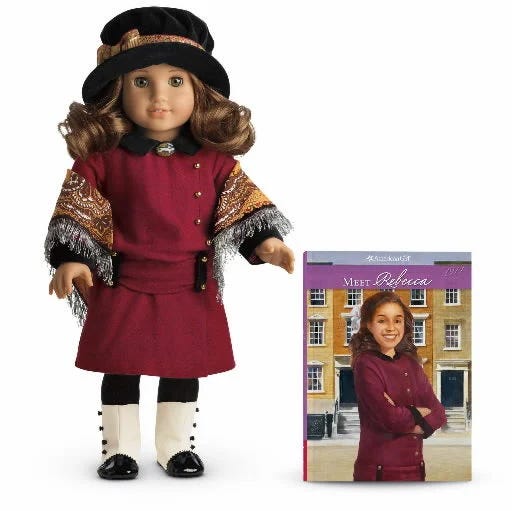
Dolls like American Girl Dolls can afford to be more multifaceted because their dolls come with books where they can tell a long and rich story that includes various things from that doll’s culture. Take Rebecca Rubin, the first Jewish American Girl Doll that I wish existed when I was little. I would have loved her, as a half-Jewish girl growing up in the tristate area! She isn’t a “stereotype,” per se. She does love musicals, which is a bit on the nose, so to speak, but her release didn’t offend people because there was no need to denote her Jewishness in just one outfit or accessory. She had a Jewish last name, a book, a family, and lore. For that matter, the same was true of the first Hispanic American Girl Doll, Josefina.
This is also true of films that rely on the emblems of different cultures—they can employ a variety of cultural elements, from names to music to traditional folklore to tell a story that represents a culture. See: Coco, Encanto, Moana, etc.
But just imagine if Barbie were to release a Jewish doll—not a Hanukkah doll, but a Jewish doll. How exactly would they denote “Jewish?” Would she come with bagels? Would she have a bigger than average nose? If she had a small Barbie nose, would that be “whitewashing” her heritage, while a bigger nose would be relying on antisemitic tropes? Would she have curly hair, or would that also be a stereotype? Would she come with some kind of evidence of lactose intolerance? It terrifies me to think about the Discourse that would surround the first Jewish Barbie, and I’m not even touching whether or not she would support Israel.
When it comes to limited edition Barbies, they don’t have the long backstory or full wardrobe—you need to convey the entire culture or group you’re trying to represent with one outfit and maybe a few accessories. This means that almost any Barbie who exists to show representation of a marginalized group will, by default, be relying on some visible cliches—nothing deeply harmful or bigoted, of course, but something anyone could see and recognize as “that thing.” If Mattel had created the fan art autistic Barbie shown at the top of this article, it would not have been identifiable as an autistic Barbie, just a Barbie who dresses terribly. Also, nobody would buy it!
Plus, consider how offensive it would be to autistic girls if the only autistic Barbie was also the only one that looked like shit. All the other Barbies get to be pretty and feminine, but the autistic Barbie has to look frumpy and geeky? Do we really think such a decision would not warrant even more backlash?
Dolls aside, all of this speaks to the larger issue of the fact that attempting to represent a marginalized group in a quick and visual way will, every single time, offend someone. Not because those people are all crazy woke loonies (although some are) but because this type of representation relies on recognizable symbols and images that will always flatten an otherwise diverse group of people.
There is also the fact that some people simply want to be offended. When Moana was announced in 2014, I was lurking on Tumblr (I know, I know) and some blogger randomly declared, “I’m already offended on behalf of the Pacific Islander community. I just know they’re gonna fuck this one up.” This stuck with me so much because it was a great example of a very 2010s mindset of assuming worst possible intent long before any sin was even committed, even when the obvious intent was to embrace multiculturalism and diversity. At that point, why even bother?
This type of thinking put many writers and artists in a bind, because if they weren’t part of any marginalized group themselves, they had a choice: represent marginalized groups in their work and create diverse media that was bound to be “unrealistic” or offensive to at least one opinionated reviewer, or stick to writing what they knew (themselves) diversity be damned. In many ways, the latter choice was less likely to offend.
Around this time, I also lurked on Reddit’s writing subreddit, where panicked writers often asked how they were supposed to describe their characters if they were people of color without saying anything racist or bluntly saying, “This guy was Chinese.” Some of them were told never to describe or mention the physical traits of a character of color at all. Others were told they should write their entire book without ethnicities or races at all (which realistically, most people would just read as “all white.”) Others were told to rely solely on characters’ names to denote race, which would work for someone with an ethnic last name, but not every person of color has an easily-recognizable name.
None of this means that all representation is good, or that any depiction that isn’t deliberately demeaning or mocking is automatically perfect. But when representation yields more backlash than a lack of representation, there is very little incentive for companies, studios, writers, or anyone else, to lean into diversity of any kind. Moreover, kids’ toys, movies, or books aren’t meant to be completely relatable, and are often meant to invoke some sense of fantasy, whimsy and aspiration. This means that presenting marginalized groups (or anyone, for that matter) exactly as they are in real life is not exciting or fun. Autistic Barbie doesn’t look anything like real autistic girls—but Neurotypical Barbie famously didn’t look realistic either.
In fact, three years ago, Barbie released a doll with Down Syndrome in an effort to reach out to little girls with the condition, and big surprise, they also got the feedback that the doll didn’t look realistic enough.
Personally, I will wait to get offended until Barbie releases a doll with OCD. If they are unable to visually represent my 6,793,234 weekly ChatGPT queries asking about rare diseases and instead denote OCD with a bottle of hand sanitizer, I will be deeply disappointed in them.



Write a comment