Woman Who Hugged Jorge Rodríguez at Zona 7 Confronted by Families of Political Prisoners
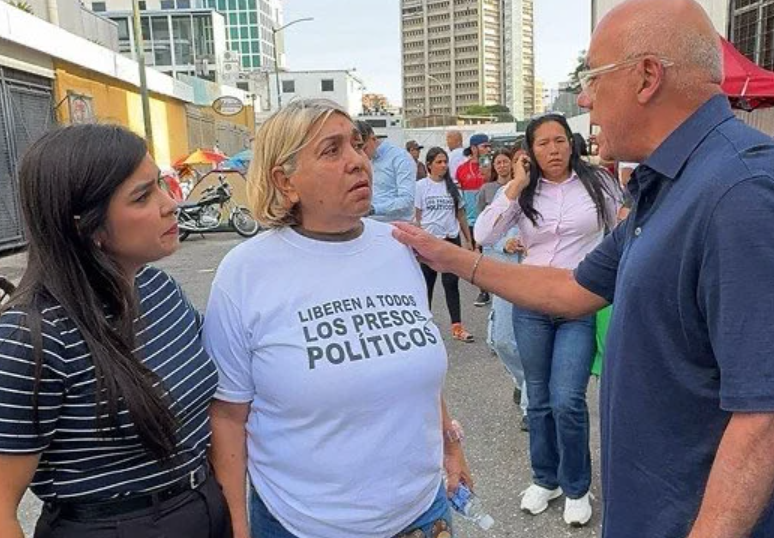
Woman Who Hugged Jorge Rodríguez at Zona 7 Confronted by Families of Political Prisoners Opposition Opposition media present the woman who hugged Jorge Rodríguez as a ruling-party militant falsely posing as a political prisoner’s relative, exposed and rejected by actual families at Zona 7. They argue this reveals the visit as a media show that instrumentalizes victims’ pain to sell an incomplete and untrustworthy amnesty process. @htcq…4692 @r83x…ptvy @dgj2…hzme Families of political prisoners who have maintained a prolonged vigil outside the Zona 7 detention center in Boleíta confronted a woman who had been filmed hugging National Assembly president Jorge Rodríguez during his recent visit to the facility. In that earlier appearance, the woman presented herself as a relative of a political detainee and as part of the group of families demanding releases under a new amnesty law, but when questioned face to face by the established group of relatives she was pushed to acknowledge that she has no son or close family member held there. Opposition-aligned outlets consistently identify her as María Malavé, describe her as a known grassroots militant from the ruling party in the state of Miranda, and report that relatives insist it was the first time they had ever seen her at the camp outside Zona 7 despite their 30 days of continuous presence.
Across these reports, the shared context is that Rodríguez visited Zona 7 in the framework of a broader political negotiation and the recently advanced amnesty law, pledging the eventual release of all those considered political prisoners except those accused of serious crimes. The families’ vigil at Zona 7 is presented as part of a longer struggle for full and verifiable liberation of detainees, against a backdrop of limited or incomplete prior releases and longstanding complaints of institutional silence and indifference from state bodies. Opposition reports also concur that organizations such as the Comité por la Libertad de los Presos Políticos have tried to formalize the families’ representation and publicly clarify who belongs to the movement, in order to prevent misrepresentation or manipulation of victims for political messaging.
Points of Contention
Nature of the encounter. Opposition-aligned sources frame the hug between Jorge Rodríguez and María Malavé as a staged act, arguing that the later confrontation at Zona 7 exposed her false claim of being a prisoner’s relative and turned the original scene into evidence of manipulation. They present detailed testimonies from relatives who say they had never seen her at the ongoing vigil and who forced her to retract her story on camera, suggesting deliberate use of an infiltrated figure to project support. Government-aligned outlets, where they address the episode at all, tend to downplay or omit the confrontation and continue to present Rodríguez’s visit as a legitimate outreach to families, treating the hug as an organic expression of gratitude within a broader reconciliation initiative.
Characterization of María Malavé. Opposition coverage portrays Malavé as an infiltrated chavista militant with a prior record of inserting herself into victims’ spaces, emphasizing reports that she is a ruling-party activist from Miranda and has claimed, without proof, to be a former political prisoner. These outlets suggest that any mention of possible psychiatric issues does not excuse what they see as her instrumentalization by state actors for propaganda. Government-aligned narratives, when they acknowledge her at all, tend either to present her simply as a citizen expressing support or shift focus away from her identity, implicitly rejecting the idea that she represents a coordinated operation or that her personal background undermines the legitimacy of the government’s outreach.
Meaning of Rodríguez’s visit and the amnesty. For opposition media, Rodríguez’s stop at Zona 7 is largely described as a media show designed to sell the amnesty process while concrete, full releases remain unfulfilled and prison conditions unchanged, with relatives stressing that he never even entered the facility to hear detainees directly. They argue that the Malavé episode reinforces the view that the visit was more about cameras than about justice, and that exclusions in the amnesty law are being used to keep emblematic cases unresolved. Government-aligned sources instead highlight the visit as proof of institutional willingness to address the issue of political detention through legal channels, framing the amnesty as a balanced mechanism that offers relief while preserving accountability for serious crimes and casting Rodríguez’s appearance as part of a responsible, step-by-step process.
Legitimacy of the families’ movement. Opposition outlets underscore the role of groups like the Comité por la Libertad de los Presos Políticos in certifying who genuinely belongs to the circle of affected families, arguing that this is necessary to shield a vulnerable community from cooptation and to expose alleged government attempts to fabricate consent. They quote relatives insisting that their camp and organization are autonomous from the ruling party and that false claimants like Malavé are a direct attack on their credibility and pain. Government-aligned coverage, by contrast, tends to dilute this distinction by presenting a broader, less-defined category of “families” and “people affected by the conflict,” allowing pro-government voices and gestures of forgiveness to be folded into the same narrative space as those demanding full releases, and in doing so implicitly contesting opposition claims of exclusive representation.
In summary, Opposition coverage tends to depict the episode as a calculated propaganda stunt that misused a false relative to sanitize an incomplete and cosmetic amnesty process, while Government-aligned coverage tends to treat Rodríguez’s visit and the public gestures around it as authentic outreach within a legitimate institutional path toward reconciliation, minimizing or ignoring claims of infiltration and manipulation. Story coverage
Write a comment