Bitcoin Cash Beyond Speculation: Building a Circular Economy in Mozambique


In Mozambique, where I live and work, financial problems are not abstract. They are daily, practical, and very real. Many people don’t have access to proper banking, international payments are expensive, and inflation slowly eats away at people’s savings. In this context, I realized that cryptocurrency only makes sense if it actually works as money — something people can use in real life.
---
## A long journey in the BCH community
s_!GrWe!,w_1456,c_limit,f_auto,q_auto:good,fl_progressive:steep/https%3A%2F%2Fsubstack-post-media.s3.amazonaws.com%2Fpublic%2Fimages%2Fa0a2c2ac-6883-4efc-9ef6-7246e744c8ac_2048x2048.jpeg)
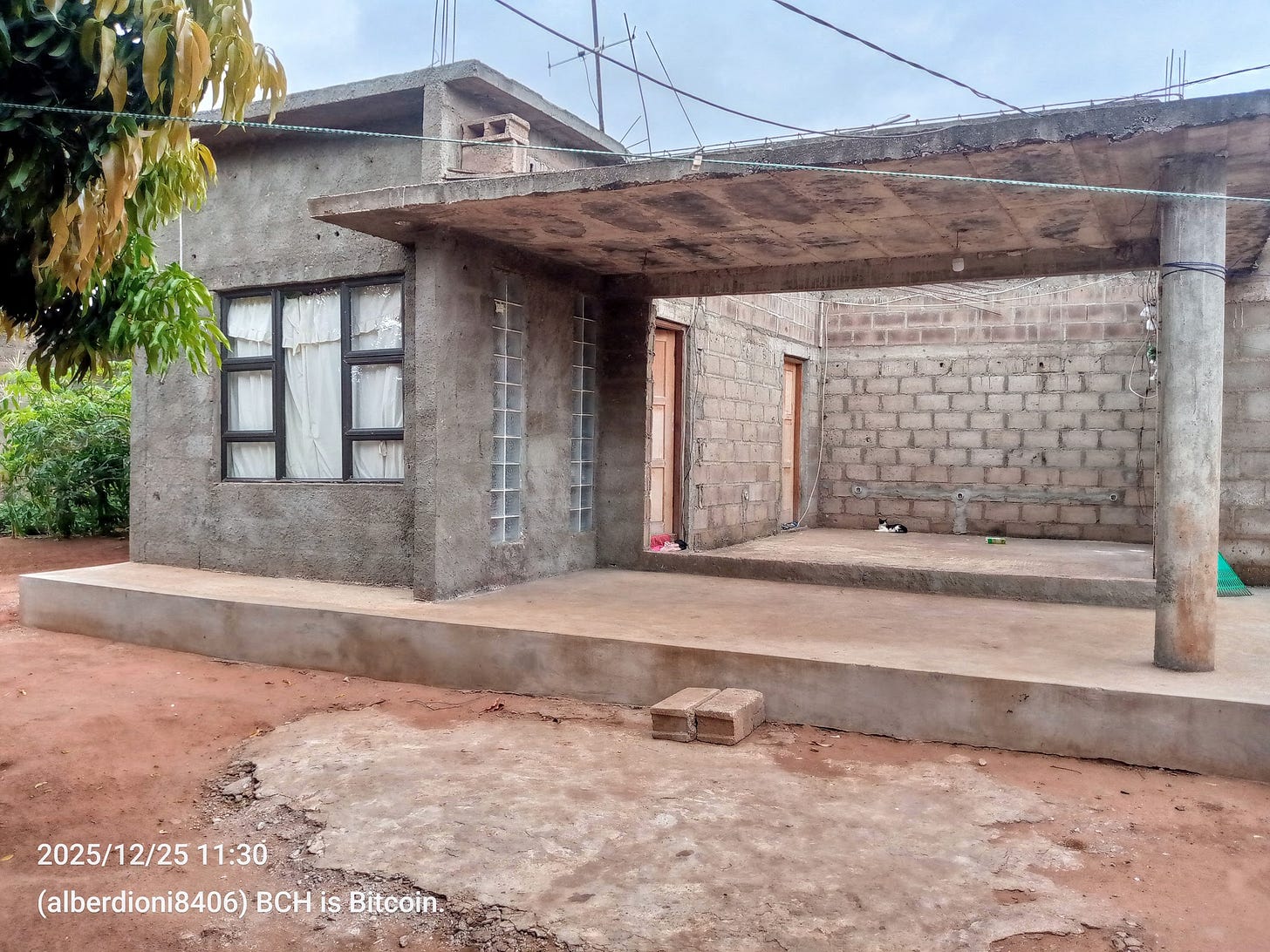
I’m not new to the Bitcoin Cash community. I have been part of it for over seven years — soon completing my eighth year — and I have always admired BCH. Living in Africa, where the minimum wage rarely exceeds $100, BCH has personally helped me in many ways.
One of my personal projects has been using BCH to fund the construction of my own house. I managed to raise enough to build the walls, and while I haven’t completed the project yet due to limited funding, the work is well underway. This experience taught me the tangible value of BCH: it’s not only digital money but a tool to empower people and make things happen in real life.
Before organizing meetups, I was primarily a content creator. I’ve written extensively about BCH on platforms like Read.cash, Bastyon, Substack, and maintained a presence on X, Reddit, and other channels — sharing insights, tutorials, and updates about the ecosystem. My work online laid the foundation for later community-building offline, connecting with people, answering questions, and spreading awareness about BCH in a practical, educational way.
Over the years, I’ve witnessed many important milestones in the BCH ecosystem:
- the split that created eCash (XEC),
- the development and deployment of Cashtokens,
- BCH climbing back to **\(1,620 per unit in 2021**, - and countless technological and community developments along the way. I’ve also had the opportunity to interview **OGs of BCH**, and engage with people online, spreading awareness and education about BCH. But it’s not just online work — I have also been active **on the ground in Mozambique** with CHAPA BCH Mozambique and the meetups I organize. I plan to run these more consistently, of course, **once we receive sufficient support**. This long-standing engagement gives me a perspective many newcomers lack: I see both the **potential and the pitfalls**, the highs and lows, and the importance of **practical, real-life adoption** rather than speculation. --- ## From curiosity to real-world meetups s_!8bk1!,w_1456,c_limit,f_auto,q_auto:good,fl_progressive:steep/https%3A%2F%2Fsubstack-post-media.s3.amazonaws.com%2Fpublic%2Fimages%2F632d54ff-f5e9-4962-8043-6bd1bd2f64e9_2048x1536.jpeg)

My first step in Mozambique was simple: education.
I started organizing small meetups in Matola, a city near Maputo, where I invited students and young workers to talk about Bitcoin Cash. Not as an investment, but as a tool: how to receive it, how to store it safely, how to send it, and most importantly, how to use it.
Instead of PowerPoint presentations, I focused on practical demonstrations:
- installing wallets,
- scanning QR codes,
- sending small amounts between each other,
- and seeing transactions confirmed in seconds.
For most people, this was the first time they saw digital money that actually felt like cash. No bank, no paperwork, no permission.
That moment — when someone realizes *“I can really use this”* — is where adoption truly starts.
---
## The story that stayed with me
One of the moments that marked me the most didn’t happen at a meetup.
One day, I gave a ride to a worker I had just met. During the trip, we started talking about life, work, and money. Eventually, I told him about Bitcoin Cash and what I was trying to build with community education.
He was newly married and very interested. He said the idea of a global, open money made sense, especially for someone like him, who works hard but struggles with traditional financial systems.
I invited him to my first official meetup, which happened on December 20th.
Unfortunately, he couldn’t attend. He was working that day and couldn’t leave his job. But he sent me a message saying he was disappointed to miss it and promised he would attend the next one.
That next meetup is on February 21st.
For me, that story represents something important: real adoption is not about numbers on a chart. It’s about real people with real schedules, real responsibilities, and real interest — even if they can’t always show up immediately.
Trust and curiosity take time.
---
## CHAPA BCH Mozambique: From an Idea to a Real Transportation Network
s_!0tJa!,w_1456,c_limit,f_auto,q_auto:good,fl_progressive:steep/https%3A%2F%2Fsubstack-post-media.s3.amazonaws.com%2Fpublic%2Fimages%2Fbc79fd3a-0643-4791-b45a-8093387e5916_1536x2048.jpeg)
CHAPA BCH Mozambique is not just an educational project. It is a transportation initiative where people can actually pay for rides using Bitcoin Cash.
The idea started small. I imagined a simple system where riders could pay in BCH, and drivers could choose whether to receive BCH or local currency (metical). The important part was that all value would ultimately flow back into BCH, strengthening a real circular economy.
The concept resonated with the Bitcoin Cash community, and the project received initial funding support. That was the moment it stopped being just an idea and became a real experiment.
The model is simple but powerful:
- riders pay using BCH or local wallets,
- drivers receive BCH or metical,
- all flows are converted into BCH,
- and the system promotes continuous usage instead of speculation.
In practice, this means people are not just holding BCH — they are using it for mobility, one of the most essential services in daily life.
When reality hits: floods and interruption

In 2026, Mozambique was hit by severe floods that devastated many parts of the country. Streets were destroyed, transport became impossible in several areas, and many businesses were forced to stop.
CHAPA BCH was no exception.
There was simply no way to operate: no roads, no movement, no safety.
For a while, everything had to pause.
But this was also a reminder of something important: real adoption is tied to real life. It is affected by weather, infrastructure, politics, and social conditions. This is not a simulation. This is reality.
---
## Back to the streets
Now the floods have stopped.
Schools are reopening.
Jobs are restarting.
Businesses are coming back.
And CHAPA BCH is also returning to the streets.
Slowly, carefully, but with more experience than before.
People who already had BCH are using it again.
New users are curious.
Drivers are motivated because they see it working.
This time, the project is not just an experiment.
It is a **living system**.
Still embryonic, yes.
But real.
Functional.
And growing.
---
## A report will come — when the time is right
When CHAPA BCH reaches a more mature stage, I plan to publish a full report:
- what worked,
- what failed,
- how many people used it,
- how value circulated,
- and what lessons were learned.
Not to promote anything.
But to document something rare in crypto:
A real business.
In a real country.
With real people.
Using Bitcoin Cash as real money.
---
## Circular economy is built with small steps
s_!pzJY!,w_1456,c_limit,f_auto,q_auto:good,fl_progressive:steep/https%3A%2F%2Fsubstack-post-media.s3.amazonaws.com%2Fpublic%2Fimages%2F5f5f330e-efaf-4813-af7d-e10a2b242ffb_1536x2048.jpeg)
A circular economy doesn’t start with big businesses. It starts with two people.
One person receives BCH. Another person accepts it. And both trust that it has value because it works.
In my meetups, I always emphasize this: You don’t need mass adoption first. You need micro adoption that grows organically.
When students see:
- their friend paying for something with BCH,
- or someone receiving BCH and smiling because it was fast and simple,
their fear disappears.
They don’t need to understand cryptography or blockchain theory. They just need to see that it works.
That’s why I always focus on:
- real demonstrations,
- real use cases,
- and real stories.
Technology alone doesn’t create trust. Experience does.
The human factor matters more than the technology

One mistake many crypto projects make is assuming that better technology automatically leads to adoption.
In my experience, this is wrong.
People don’t adopt technology.
People adopt *solutions to their problems*.
In Mozambique, those problems include:
- expensive remittances,
- limited access to international payments,
- lack of financial inclusion,
- and dependence on centralized systems.
Bitcoin Cash solves many of these issues, but only if someone explains it patiently, face-to-face, and in simple language.
Most people are afraid of losing money.
They are afraid of scams.
They are afraid of doing something wrong.
So the real work is not technical.
It’s emotional and social.
It’s about building confidence.
---
## Meetups are not events — they are relationships
I don’t see meetups as marketing events.
I see them as the beginning of relationships.
When someone attends a meetup, installs a wallet, and sends their first transaction, they are not becoming “a user”.
They are becoming part of a network of trust.
They know they can ask questions.
They know they can make mistakes.
They know someone is there to help.
This is why physical presence matters so much in adoption.
Online education is useful, but real trust is built offline.
Especially in places like Africa, where community and personal interaction are fundamental.
---
## Beyond speculation, towards utility
Most of the crypto world is still obsessed with price.
But price does not create value.
Utility does.
A currency has value when:
- people use it,
- people understand it,
- and people trust it.
In my work, I don’t talk about “the next bull market”.
I talk about:
- sending money without banks,
- protecting yourself from inflation,
- and building financial independence.
Speculation may bring attention.
But utility brings sustainability.
---
## The future I believe in
I don’t believe in overnight revolutions.
I believe in slow, consistent progress.
One meetup at a time.
One person at a time.
One transaction at a time.
The worker I gave a ride to will attend the February 21st meetup.
Maybe he will bring a friend.
Maybe that friend will tell someone else.
That’s how real adoption spreads.
Not through influencers.
Not through hype.
But through human connections.
---
## Final thoughts
s_!mPIA!,w_1456,c_limit,f_auto,q_auto:good,fl_progressive:steep/https%3A%2F%2Fsubstack-post-media.s3.amazonaws.com%2Fpublic%2Fimages%2F9723f46e-261e-4db9-bdde-4151b5276986_1536x2048.jpeg)
Bitcoin Cash does not need to “conquer Africa”. Africa just needs tools that work.
In Mozambique, I see every day that people are ready. They are curious. They are practical. They are open.
What they need is not promises. They need:
- education,
- simple tools,
- and real examples.
CHAPA BCH Mozambique is my small contribution to that vision.
Not a company. Not a startup. Just a community trying to build something real.
Beyond speculation. Beyond price charts. Towards real, usable money.
Support and Connect
If you enjoyed this article or want to support my work with Bitcoin Cash, you can send tips to my BCH address:
BCH Tips:

bitcoincash:qrtu43zrh58wzkqhvzs95gxsfnlw2mg9kvqg2u8a8n
You can also follow me and read more about Bitcoin Cash on my platforms:
Blogs & Content:
Social Media & Community:
- X (Twitter)
- Telegram: @alberdioni8406
Thank you for supporting real adoption, education, and content creation around Bitcoin Cash!


Write a comment