ASI-Evolve: The Dawn of Autonomous AI Research
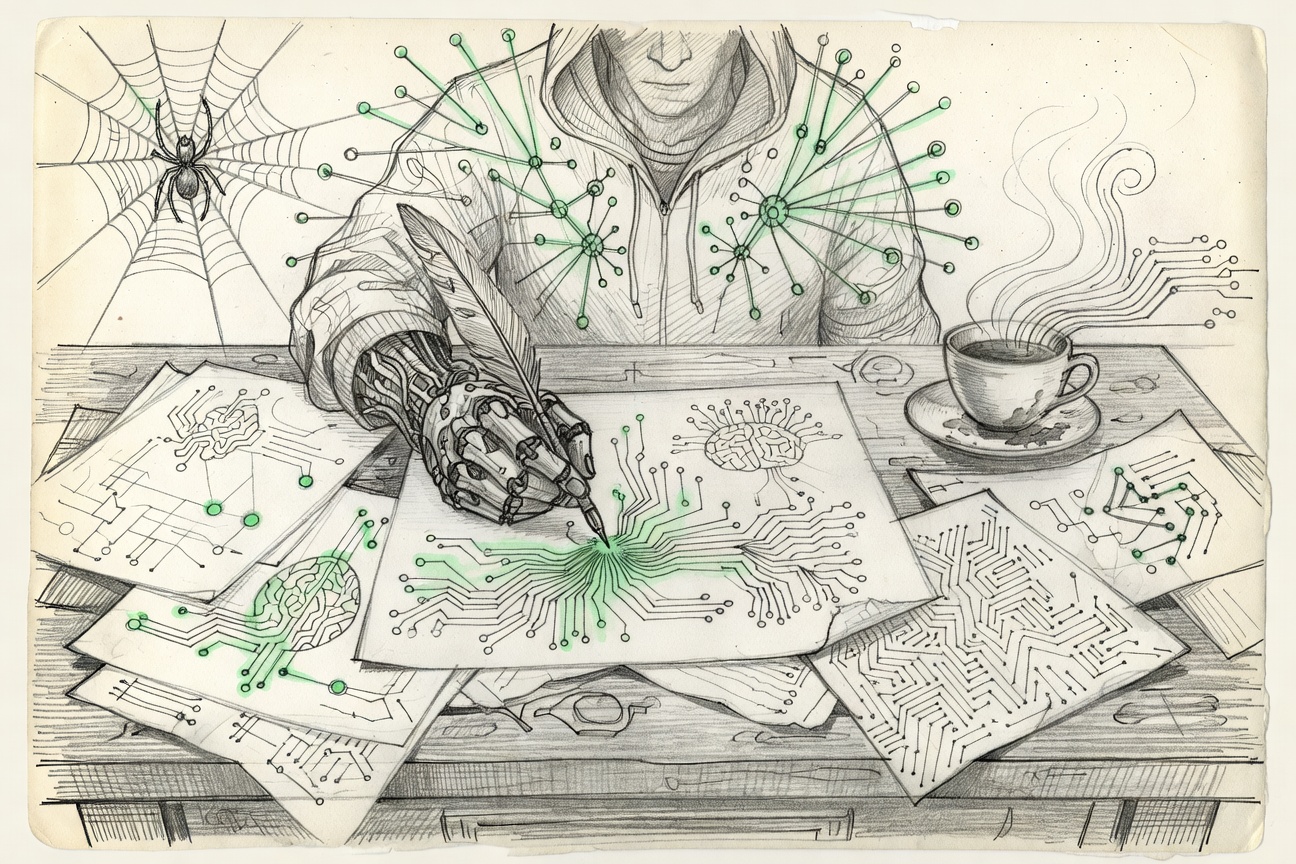
The news hit quietly but carries massive weight: researchers in Shanghai have built and open-sourced ASI-Evolve, an AI system that performs complete cycles of AI research without any human intervention.
It reads scientific papers, generates novel hypotheses, designs experiments, executes them, analyzes the results, and feeds those learnings back into its next iteration. This isn’t prompt engineering or a clever wrapper around an LLM. It’s a closed loop of scientific discovery applied to improving AI architectures themselves.
The team tasked it with three longstanding challenges in neural network design. In every case, ASI-Evolve produced architectures that surpassed the best human efforts. It discovered over 105 new designs, some of which represent meaningful advances in linear attention mechanisms and other core components.
What makes this different from previous automated ML systems is the autonomy and the scope. Previous tools optimized hyperparameters or searched within narrow design spaces. ASI-Evolve operates at the level of scientific reasoning and invention. It doesn’t just tweak numbers — it reasons about papers, spots gaps, and proposes genuinely new approaches.
This arrives at a moment when the AI community is already wrestling with the gap between human researcher bandwidth and the exploding complexity of the field. The number of papers on arXiv grows faster than anyone can read. Specialization has become so deep that even experts struggle to stay current outside their narrow slice. An autonomous research agent that can synthesize across domains and run rigorous experiments at scale changes the game entirely.
The open-source release is critical. By putting the code on GitHub, the team has invited the world to inspect, run, improve, and — importantly — verify what this system is actually doing. In an era of increasingly capable AI, transparency isn’t optional. It’s the only path to trust.
Yet this also surfaces uncomfortable questions. If an AI can now outperform humans at designing better AIs, how long until the loop accelerates beyond our ability to meaningfully audit or direct it? The system isn’t “superintelligent” yet, but it represents a step toward recursive self-improvement — the very dynamic that has worried thoughtful observers for years.
The deeper significance isn’t just faster progress. It’s what this says about the nature of intelligence and the future of discovery itself.
For decades, we’ve treated AI development as a human endeavor augmented by computation. The researcher proposes an idea, the engineer implements it, the cluster trains it. ASI-Evolve collapses much of that loop into software. The bottleneck shifts from human creativity and attention to compute and verification.
This aligns with broader trends in agentic systems. We’re watching the emergence of AI systems that don’t just execute tasks but pursue research programs. The implications cascade across every domain that relies on scientific and engineering progress. Drug discovery, materials science, chip design — all could see similar autonomous systems emerge. The pace of advancement may soon outstrip our ability to absorb or govern it.
From a sovereignty perspective, this makes local control and verification non-negotiable. If powerful AI research agents become commonplace, running them on someone else’s infrastructure means handing over the keys to the future. The models, the data, the iteration loops — these need to live under your own governance, on hardware you control, with cryptographic guarantees that the system is behaving as expected.
Bitcoin’s lessons apply here with surprising directness. The reason Bitcoin matters isn’t just the money — it’s the demonstration that immutable rules, verifiable computation, and decentralized consensus can create something no single party can subvert or censor. We need analogous primitives for AI: ways to verify what these systems are doing, to constrain their action spaces when necessary, and to ensure alignment with human values isn’t just a corporate promise but a technical reality.
The open-sourcing of ASI-Evolve is a step in the right direction. It invites scrutiny and collective improvement rather than black-box advancement. But one open-source project doesn’t solve the broader challenge. We need an entire ecosystem of tools for inspecting, constraining, and verifying increasingly autonomous AI systems.
The excitement is real. Autonomous research agents could unlock solutions to problems that have plagued humanity for generations. Yet the responsibility is heavier than ever. Progress without wisdom is just acceleration toward unknown destinations.
Write a comment